The ESG Maze: Fragmentation Is the Real Problem
The modern ESG landscape is not suffering from a lack of intent. Companies across industries increasingly recognise the importance of sustainability, transparency, and responsible governance. The real challenge lies elsewhere: integration.
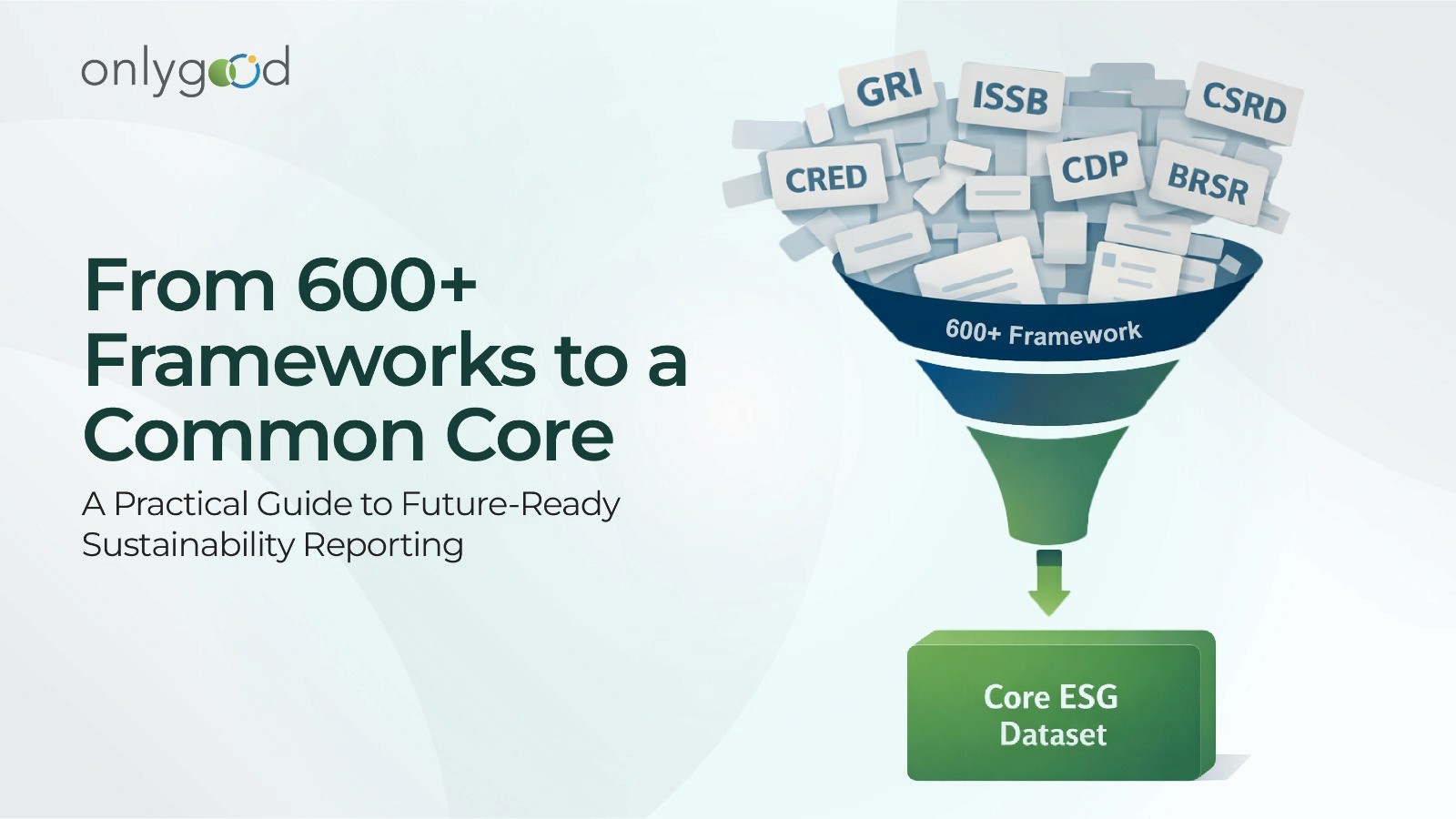
Today, organisations are navigating a dense web of reporting frameworks and disclosure requirements. What was meant to create transparency has, in many cases, resulted in fragmentation.
Most companies find themselves simultaneously managing multiple ESG obligations, including:
Global Reporting Initiative (GRI) disclosures
CDP climate questionnaires
Business Responsibility and Sustainability Reporting (BRSR) filings in India
EcoVadis sustainability assessments
Investor-driven ESG templates
Expanding regulatory mandates across jurisdictions
While each framework serves a legitimate purpose, they rarely speak the same language. The metrics may overlap, but the structure, terminology, and evidence requirements often differ. As a result, what should be a unified sustainability strategy turns into a series of disconnected reporting exercises.
Internally, this creates a familiar pattern.
Data must be collected multiple times for slightly different formats.
Teams across finance, sustainability, procurement, and operations work in parallel rather than in coordination.
New initiatives are launched to meet reporting requirements, but they are rarely integrated into core business decision-making.
The consequences are significant:
Duplicated data collection across departments and systems
Reporting fatigue among sustainability and compliance teams
Disconnected ESG initiatives that operate without strategic alignment
And most critically, no clear line of sight between ESG activity and business value
In this fragmented environment, ESG risks becoming exactly what companies fear most, a compliance burden rather than a strategic capability.
The Integrated ESG Inventory: One System, Many Frameworks
The solution to ESG fragmentation is not choosing one framework over another. Most companies cannot. Regulations, investors, customers, and supply chains will continue to demand different disclosures.
The real solution is integration.
Instead of treating every framework as a separate reporting exercise, organisations can build a single ESG inventory, a unified data architecture that maps multiple frameworks onto one underlying system.
Think of it as a master layer of ESG intelligence.
At the core sits a structured inventory of ESG indicators across environmental, social, and governance dimensions. These indicators capture the fundamental data points that organisations already generate energy consumption, emissions, water usage, labour practices, governance policies, supply chain disclosures, and more.
Once this base layer exists, the major reporting frameworks can be mapped onto it.
For example:
Global Reporting Initiative (GRI) may require detailed disclosures on environmental impacts and governance policies.
CDP focuses heavily on climate risk, emissions management, and transition planning.
Business Responsibility and Sustainability Reporting (BRSR) emphasises responsible business conduct and stakeholder impact within the Indian regulatory context.
EcoVadis evaluates sustainability performance across supply chains and operational practices.
Individually, these frameworks appear different. But underneath, many of them rely on the same core data points.
Energy consumption feeds both GRI and CDP.
Supplier due diligence informs EcoVadis as well as BRSR.
Governance disclosures overlap across investor questionnaires and regulatory filings.
An integrated ESG inventory recognises these overlaps and captures the data once, then distributes it across multiple frameworks.
The benefits are immediate:
Single-source ESG data architecture instead of scattered spreadsheets
Reduced reporting duplication across teams and departments
Consistent metrics across different disclosures
Greater audit readiness through structured, traceable information
More importantly, integration transforms ESG from a documentation exercise into a system of intelligence.
Measuring What Matters: The ESG Maturity Lens
Once ESG data is integrated into a single system, the next question becomes unavoidable: Where does the organisation actually stand?
Many companies undertake ESG initiatives without a clear understanding of their current maturity. Policies are drafted, disclosures are submitted, and projects are launched but progress often remains difficult to measure in a structured way.
An integrated ESG inventory makes it possible to introduce a maturity lens.
Instead of viewing ESG as a series of isolated actions, the organisation can evaluate itself across key dimensions governance structures, environmental performance, supply chain transparency, workforce practices, and risk management.
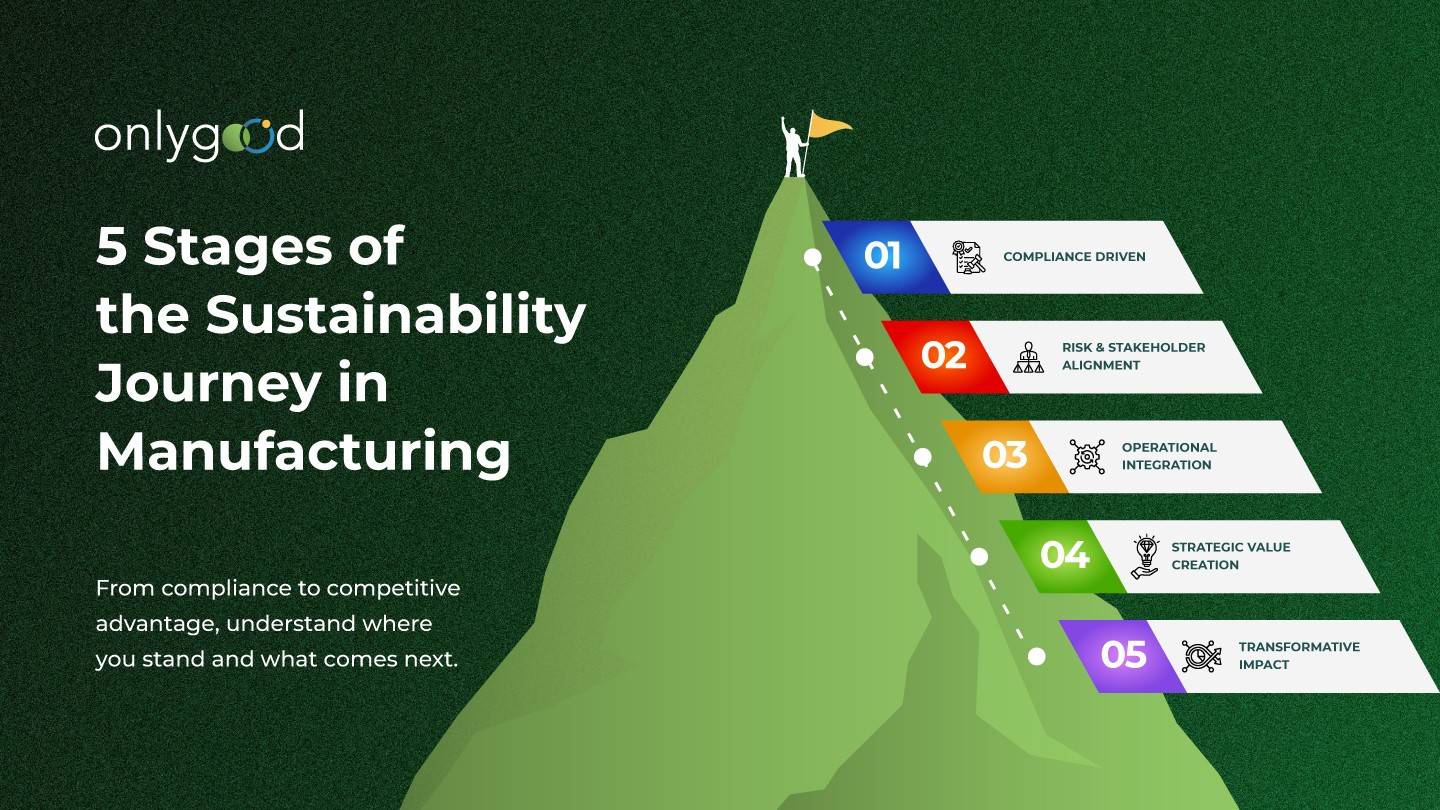
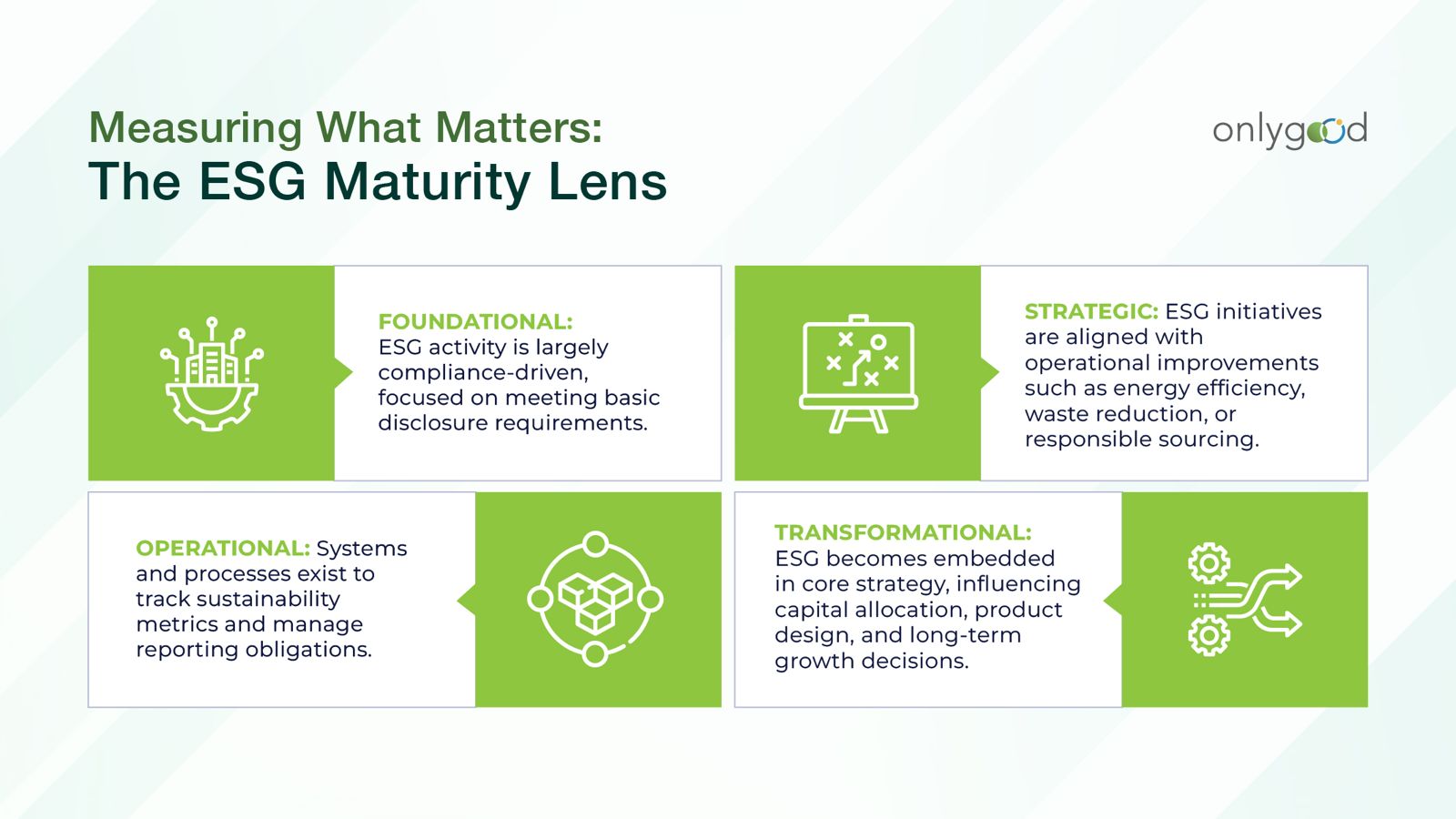
This assessment typically reveals that organisations fall across different stages of maturity:
Foundational: ESG activity is largely compliance-driven, focused on meeting basic disclosure requirements.
Operational: Systems and processes exist to track sustainability metrics and manage reporting obligations.
Strategic: ESG initiatives are aligned with operational improvements such as energy efficiency, waste reduction, or responsible sourcing.
Transformational: ESG becomes embedded in core strategy, influencing capital allocation, product design, and long-term growth decisions.
The maturity score is not static. It evolves as organisations improve processes, strengthen governance, and implement measurable sustainability initiatives.
More importantly, this maturity lens turns ESG into a roadmap rather than a checklist.
For example, a company might identify that improving shop-floor energy efficiency could significantly raise its environmental maturity. Another organisation may discover that strengthening supplier transparency is the most critical next step. Others may prioritise workforce diversity, governance oversight, or climate risk management.
Each improvement becomes a structured lever for progress moving the organisation forward on its ESG journey while strengthening operational resilience.
With maturity measured clearly, ESG stops being abstract.
It becomes a visible, trackable pathway toward better performance.
Every ESG Action Has Two Outcomes: Value and Risk
Once ESG maturity is mapped, the next step is identifying which actions will move the needle. But the real power of an integrated ESG system lies in how it evaluates those actions.
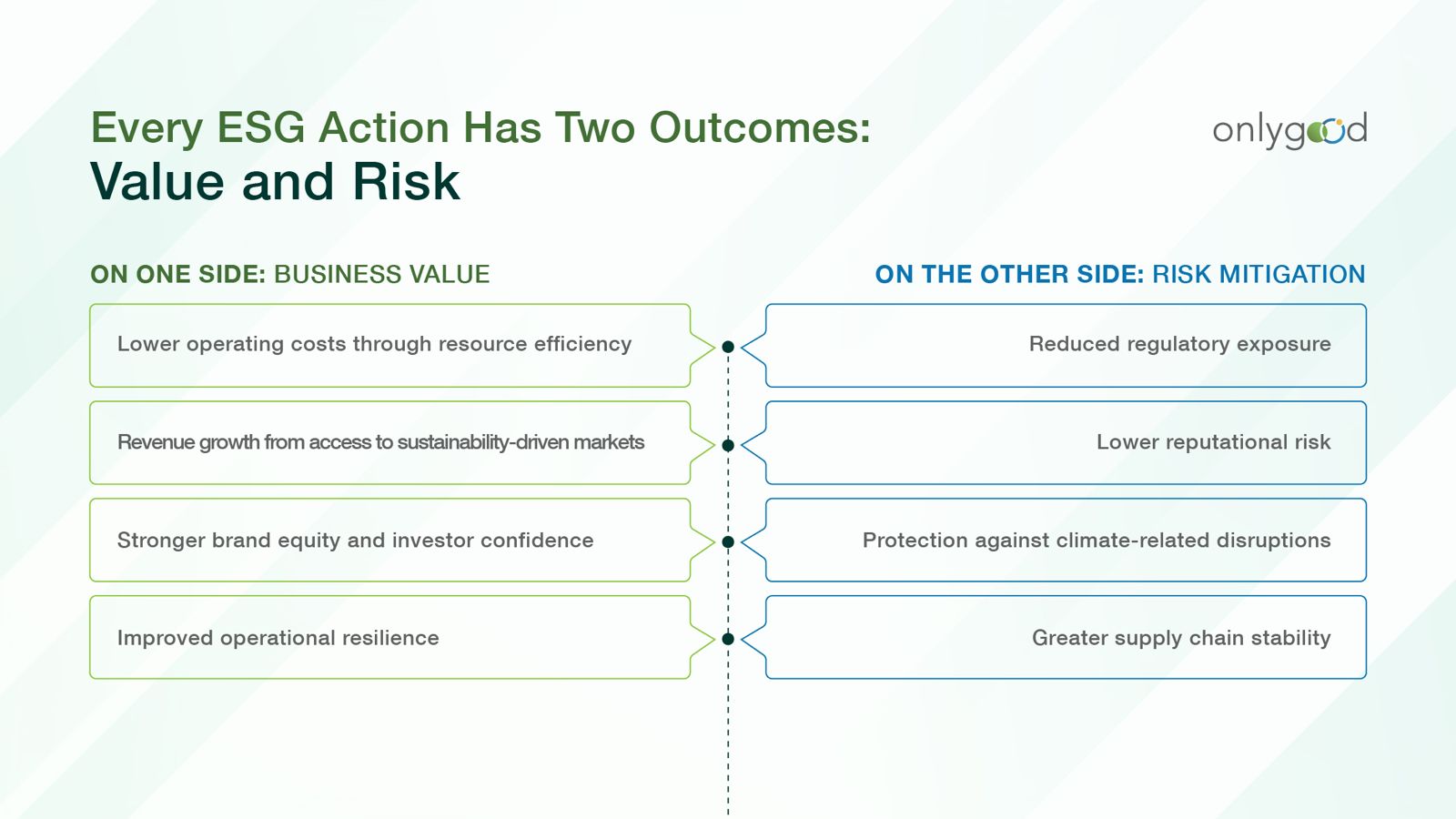
Every ESG initiative has two simultaneous outcomes: it creates business value and it mitigates risk.
Traditionally, organisations have viewed sustainability initiatives primarily through the lens of compliance. The goal was to meet disclosure requirements, satisfy regulators, or respond to investor expectations. While important, this perspective misses a much larger opportunity.
When ESG actions are analysed through an integrated framework, their business impact becomes visible.
For example, improving energy efficiency on the shop floor does more than reduce emissions. It lowers operating costs, improves resource productivity, and strengthens competitiveness in carbon-sensitive export markets. Similarly, strengthening supply chain transparency not only satisfies due diligence requirements but also protects the company from reputational and operational disruptions.
This creates a powerful dual lens for decision-making:
On one side: Business Value
Lower operating costs through resource efficiency
Revenue growth from access to sustainability-driven markets
Stronger brand equity and investor confidence
Improved operational resilience
On the other side: Risk Mitigation
Reduced regulatory exposure
Lower reputational risk
Protection against climate-related disruptions
Greater supply chain stability
When companies begin evaluating ESG actions through this value–risk framework, priorities become clearer. Instead of pursuing scattered sustainability efforts, organisations can focus on initiatives that simultaneously strengthen the business and reduce long-term exposure.
An Always-On ESG Intelligence System
Traditional ESG reporting is periodic and reactive. Data is collected once or twice a year, reports are compiled, disclosures are submitted, and the process pauses until the next reporting cycle begins.
This approach creates a fundamental limitation: ESG visibility exists only during reporting season.
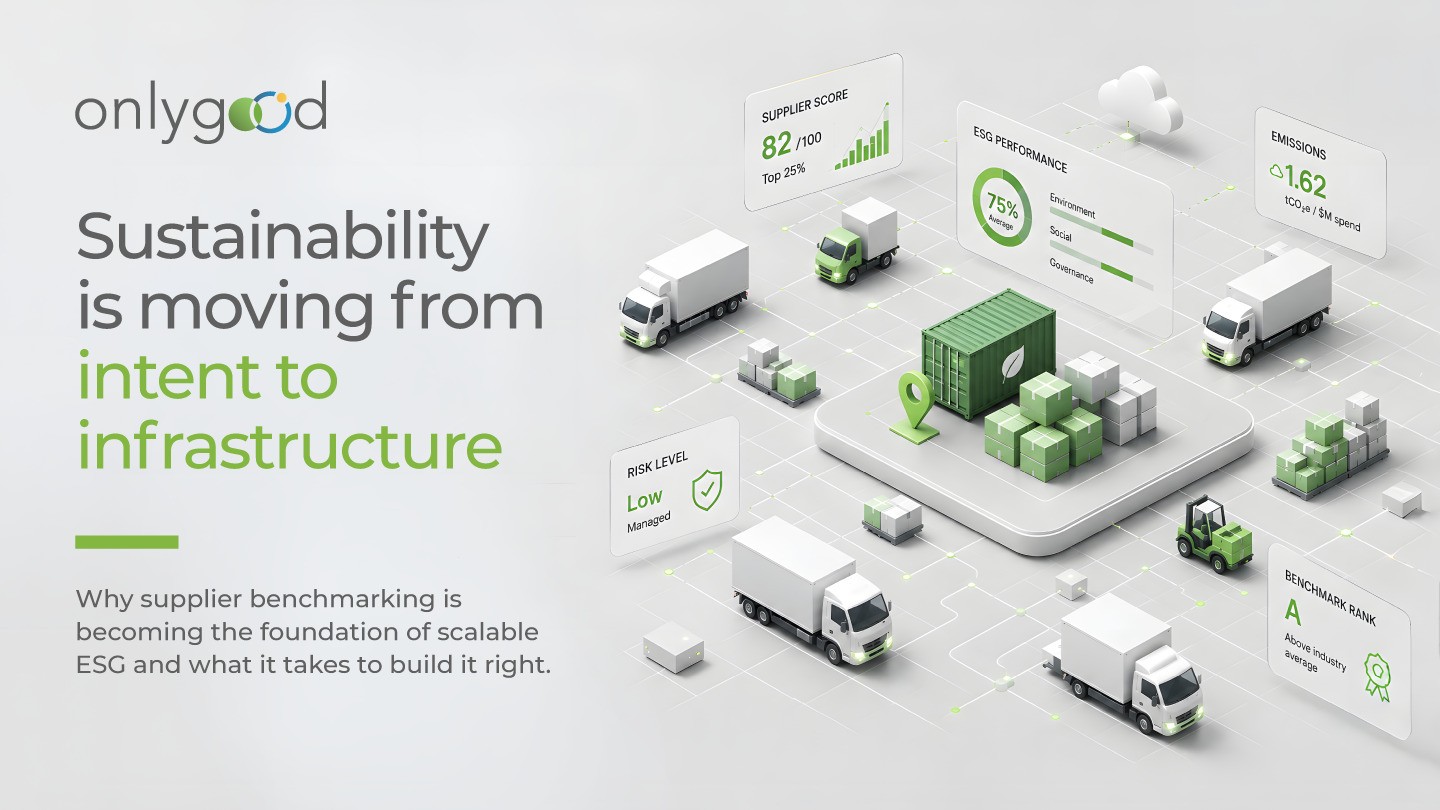
An integrated ESG system changes this dynamic entirely. Instead of treating ESG as a periodic exercise, it becomes an always-on intelligence layer within the organization.
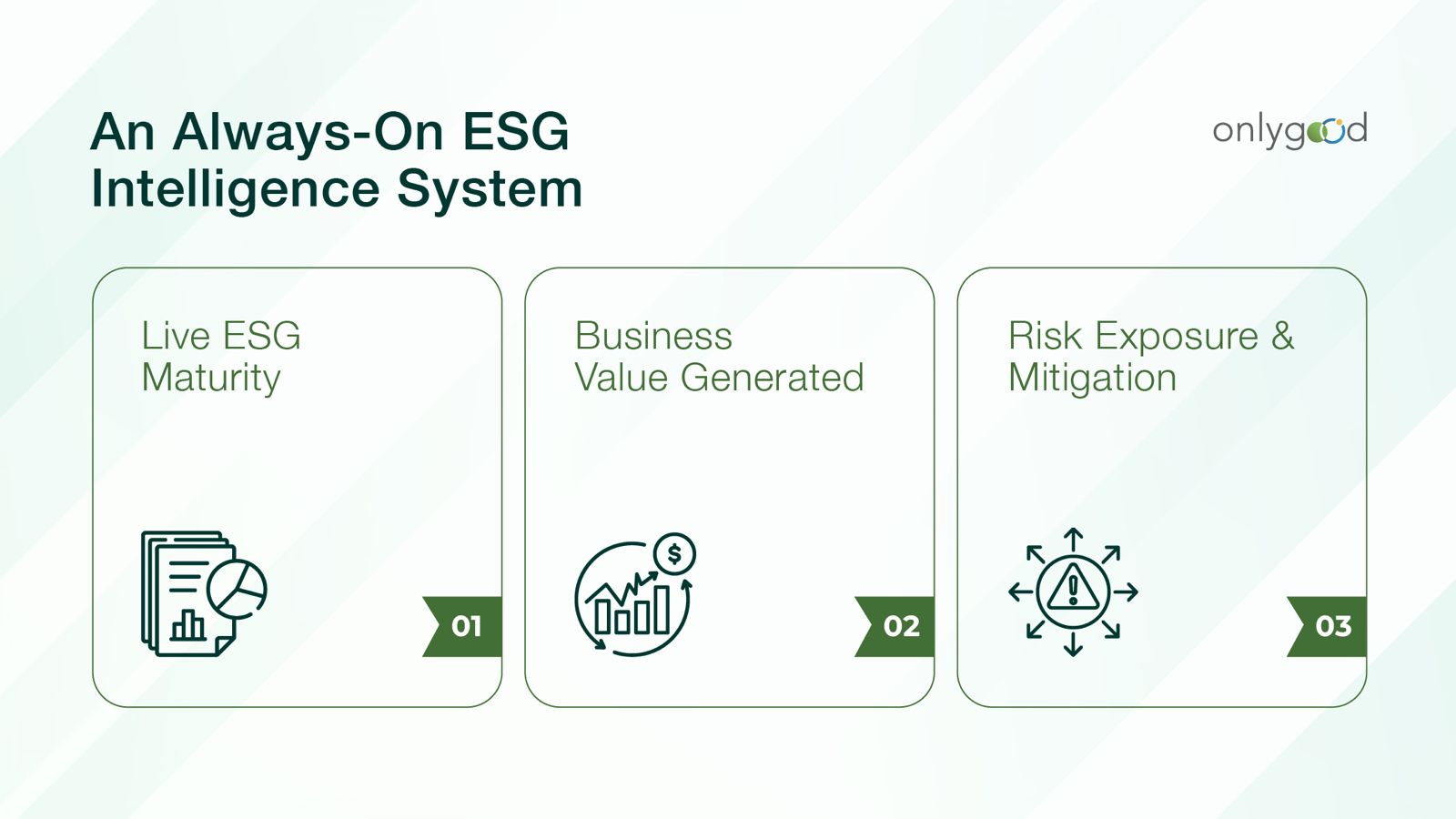
At any given moment, leadership can see three things clearly:
1. Live ESG Maturity: The organization’s maturity score is continuously updated as new data flows in and initiatives are implemented. Progress is visible in real time rather than only during annual disclosures.
2. Business Value Generated: The system tracks the tangible outcomes of ESG actions—cost reductions from energy efficiency, revenue opportunities from sustainable markets, improvements in brand perception, and operational productivity gains.
3. Risk Exposure and Mitigation: Regulatory risks, supply chain vulnerabilities, and climate-related exposures are continuously monitored. As initiatives are implemented, the system shows which risks are being mitigated and which still require attention.
This continuous visibility fundamentally changes how ESG is managed.
Instead of asking “Did we report correctly?”, leadership begins asking “Where should we act next?”
ESG shifts from a compliance-driven exercise to a real-time management system - one that guides operational decisions, strategic investments, and long-term resilience.
In this model, ESG is no longer something the company reports once a year.
It becomes something the company manages every day.
Platform-Led Services: Where Technology Meets Expertise
Technology alone cannot solve ESG complexity. Data can be processed by platforms, but context, strategy, and prioritisation require human expertise.
That is why the most effective ESG systems combine platform intelligence with expert-led services.
The platform processes thousands of ESG data points across operations, supply chains, emissions, governance metrics, and social indicators. It converts fragmented information into a structured maturity score, business value indicators, and risk insights.
But the real value emerges when experts interpret these insights and translate them into actionable roadmaps.
For example, an organization may have specific constraints or ambitions:
Achieve 40% carbon reduction by 2030
Reach a Bronze or Silver EcoVadis rating
Improve supplier ESG performance
Prioritize low CapEx sustainability initiatives
Strengthen compliance for BRSR or global reporting frameworks
A platform-led services model uses the intelligence generated by the system and applies expert judgement to design a roadmap tailored to these goals.
Instead of generic sustainability recommendations, companies receive precision-guided actions aligned with their operations, resources, and timelines.
Over the next 3, 6, or 12 months, leadership gains clarity on:
What initiatives should be prioritised
How those actions improve ESG maturity
What business value they unlock
Which risks they mitigate
This combination of technology scale and human expertise transforms ESG from an analytical exercise into a practical execution roadmap.
And that is where real transformation begins.
From Reporting Burden to Strategic Advantage
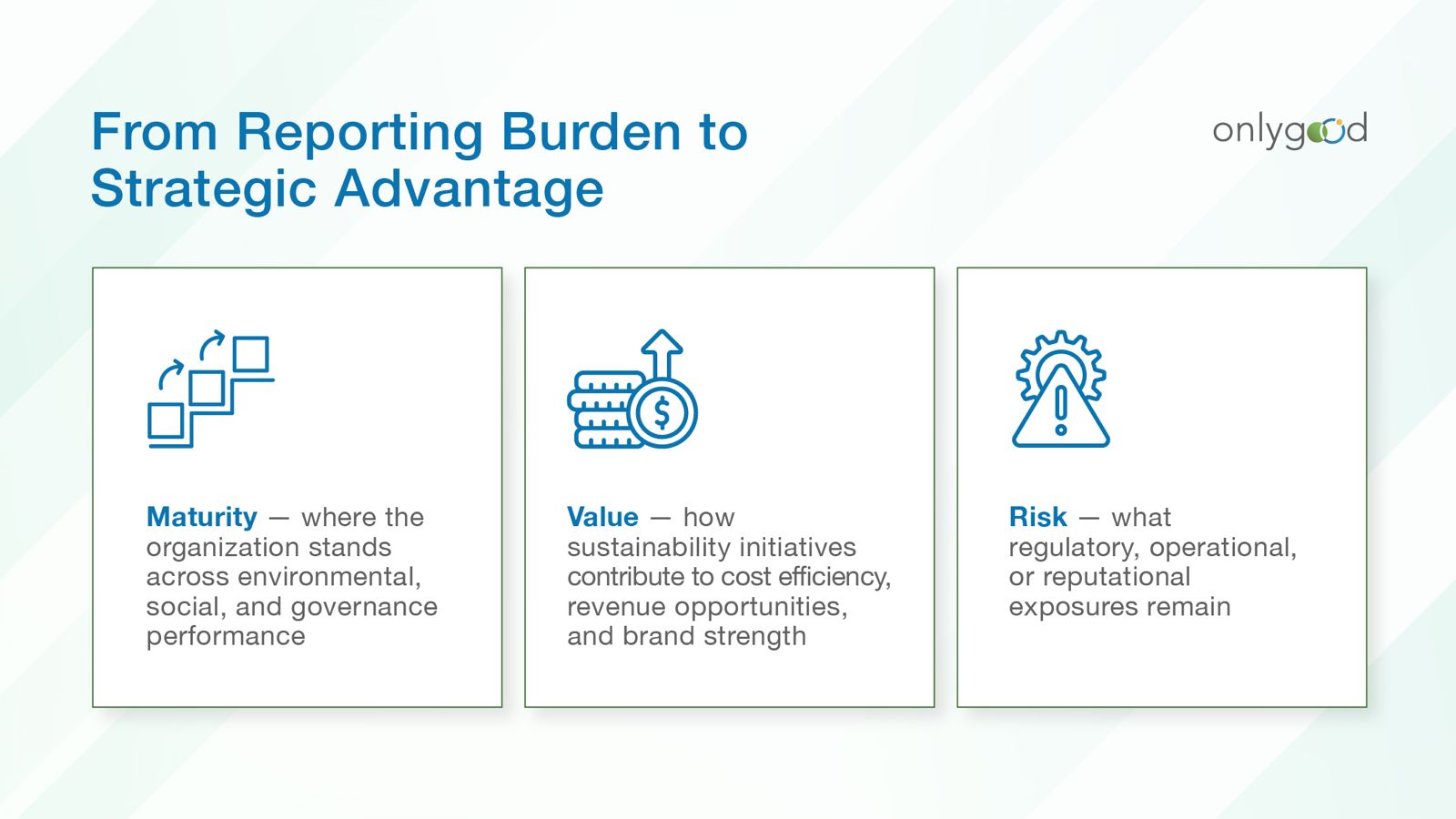
When ESG is fragmented across frameworks, it behaves like a reporting burden. Teams chase disclosures, collect scattered data, and respond to multiple questionnaires without a clear strategic outcome.
But when ESG is integrated into a single system, something important changes.
Sustainability stops being a compliance exercise and starts becoming a strategic operating layer for the business.
Leaders gain continuous visibility into three critical dimensions:
Maturity — where the organization stands across environmental, social, and governance performance
Value — how sustainability initiatives contribute to cost efficiency, revenue opportunities, and brand strength
Risk — what regulatory, operational, or reputational exposures remain
Instead of reacting to reporting cycles, companies begin managing ESG like any other business function with measurable progress, clear priorities, and defined outcomes.
The conversation shifts from: “Which framework do we need to respond to next?”
to
“What actions will create the most value while reducing risk?”
That shift from framework compliance to business clarity is what ultimately turns ESG into a long-term competitive advantage.
The Future of ESG: Always-On Intelligence
The next phase of ESG will not be defined by more frameworks.
It will be defined by better intelligence.
As regulations expand and investor scrutiny deepens, companies cannot afford fragmented reporting cycles. ESG will need to operate as an always-on system continuously measuring performance, tracking progress, and identifying opportunities.
In this model, ESG becomes a live operating dashboard, not an annual reporting exercise.
Organizations will be able to see, in real time:
How their maturity is evolving across ESG dimensions
Which initiatives are creating measurable business value
Where risk exposure still exists across regulatory, operational, and reputational fronts
This continuous visibility allows leaders to prioritize actions dynamically, rather than reacting once a year during disclosure season.
Technology plays a critical role here but not as a standalone tool. The future lies in platform-led intelligence supported by expert guidance, where data systems and domain expertise work together to translate ESG signals into clear strategic decisions.
In that world, ESG stops being an annual compliance burden and becomes something far more powerful:
A decision system for resilient, future-ready businesses.
Conclusion: From Compliance Burden to Strategic Clarity
For many organizations, ESG still feels like a maze multiple frameworks, overlapping disclosures, and constant reporting pressure. The challenge is not a lack of commitment; it is the absence of integration.
When ESG efforts remain fragmented, companies expend enormous energy collecting data and completing questionnaires, yet struggle to translate those efforts into clear business outcomes.
The shift begins with a simple but powerful idea: treat ESG as a unified system rather than a set of isolated requirements.
An integrated framework brings structure to complexity. It creates a single inventory of ESG actions, evaluates maturity dynamically, and connects every initiative to two critical outcomes: business value and risk mitigation.
This approach transforms ESG from a reactive reporting exercise into a forward-looking management system.
Leaders gain clarity on what to prioritize.
Teams understand how sustainability initiatives contribute to performance.
And organizations build a transparent pathway toward long-term resilience.
The future of ESG will belong to companies that move beyond fragmented compliance and build integrated, intelligence-driven sustainability systems.
Because ultimately, the goal is not just better reporting.
It is better business.