Introduction
ESG has rapidly moved from the sidelines to the center of business strategy. Organizations today are under increasing pressure to measure, report, and improve their environmental and social impact not just for compliance, but for long-term competitiveness.
To meet this demand, ESG solutions have evolved with strong domain expertise and high-touch service models. These approaches deliver real value helping companies navigate complex frameworks, manage data, and produce credible reports. But they come with a hidden limitation.
From data collection and validation to reporting and customization, a significant portion of the effort is repetitive and execution-heavy. As a result, even the most capable teams find themselves spending disproportionate time on work that doesn’t scale.
This creates a structural tension: the more value you deliver, the more effort you need to invest.
And that raises a critical question: how do you scale impact without scaling effort at the same rate?
This article explores that shift. It looks at why the current model feels “powerful but painful,” what truly drives retention in ESG products, and how organizations can move toward a more scalable, product-led approach.
At the core of this transformation is a simple idea: ESG needs to evolve from a service delivered manually to intelligence embedded within a product.
Where Are We Today in ESG Product Design ?
Most ESG organizations today are rich in expertise and trusted by their clients. High-touch delivery models have been effective in navigating complex frameworks and ensuring quality outcomes.
However, this model remains heavily execution-driven. A significant share of time is spent on operational tasks, data collection, validation, and customization which limits scalability.
As a result, growth stays tied to effort, creating a natural ceiling on how fast and efficiently organizations can scale.
The Paradigm Shift: From Services to Product-Led ESG
Breaking out of the current model requires a fundamental shift from service-led delivery to product-led design.
Traditionally, ESG has relied on expert-driven execution: collecting data, interpreting frameworks, and building reports. While effective, this approach ties outcomes directly to human effort.
A product-led model changes this. Instead of delivering ESG through manual workflows, capabilities are embedded into the product where data flows automatically, repeatable processes are systematized, and reporting becomes outcome-driven.
This shift redefines what ESG products deliver:
From reporting features to reliable outcomes
From static data to actionable insights
From assisted workflows to self-serve systems
The pattern behind this transition is consistent. Most organizations begin with services, where value is created through hands-on execution. Over time, repeated workflows, data structures, reporting formats, and processes become visible.
These patterns are then systematized into templates, standardized models, and internal tools, eventually evolving into scalable products.
This is the path to scale: service → system → product
As this shift happens, the role of teams evolves from executing tasks to focusing on higher-value work like interpretation, strategy, and decision-making.
For ESG organizations, the opportunity is not to replace expertise, but to embed it into systems that scale.
How to Build a Scalable ESG Product: Key Strategic Pillars
The answer lies in a few core pillars that transform ESG from a service into a system of intelligence.
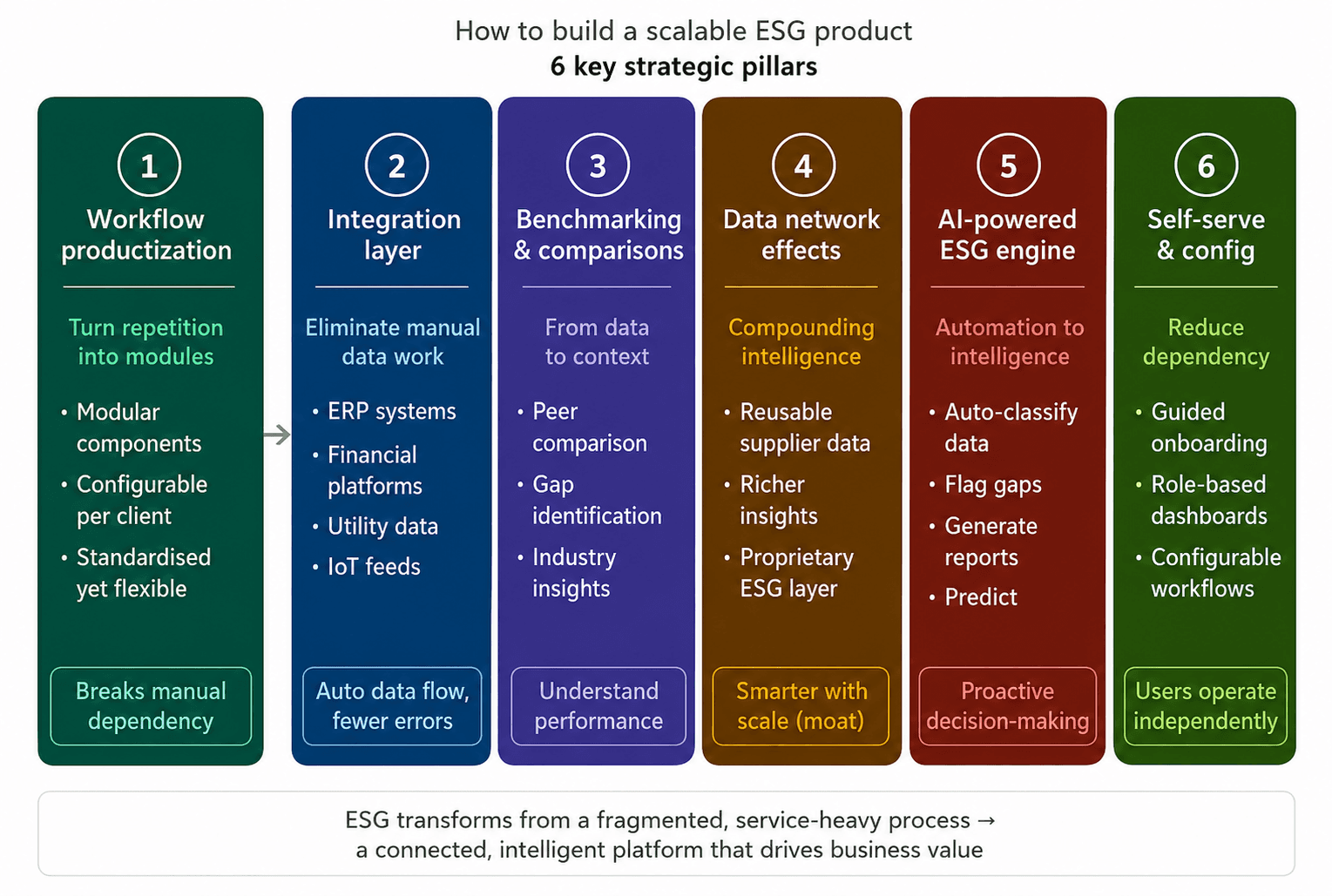
1. Workflow Productization: Turn Repetition into Modules
At the heart of ESG delivery are workflows that repeat across clients BRSR templates, Scope 1/2/3 calculations, CBAM and other reporting structures.
Instead of recreating these every time, they can be:
Modularized into reusable components
Configured based on client needs
Standardized without losing flexibility
Why it matters: This is the first step in breaking the dependency on manual execution.
2. Integration Layer: Eliminate Manual Data Work
A major bottleneck in ESG is data collection.
A scalable system connects directly to:
ERP systems
Financial platforms
Utility data sources
IoT and operational feeds
Outcome: Data flows automatically reducing errors, delays, and follow-ups.
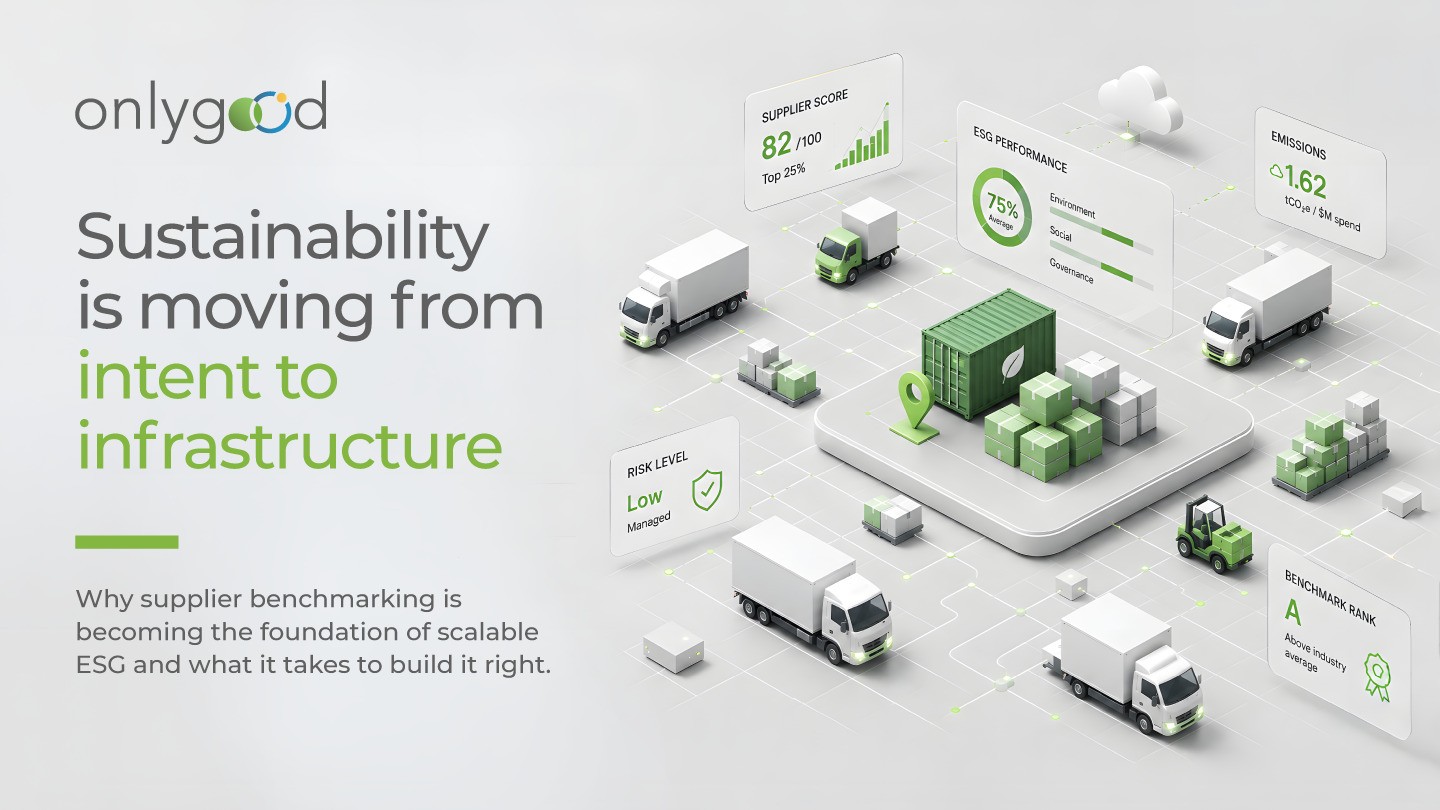
3. Benchmarking & Comparisons: From Data to Context
Raw data has limited value without context.
By building benchmarking capabilities:
Companies can compare performance across peers
Identify gaps and improvement areas
Access industry-level insights
Shift: From reporting numbers → to understanding performance.
4. Data Network Effects: Build Compounding Intelligence
As more companies use the platform:
Supplier and ecosystem data can be reused
Insights become richer and more accurate
A proprietary ESG intelligence layer emerges
This creates a moat: The product becomes smarter with scale.
5. AI-Powered ESG Engine: From Automation to Intelligence
AI moves ESG beyond automation into decision support:
Auto-classifies incoming data
Flags gaps and inconsistencies
Generates reports with minimal manual input
Surfaces predictive insights
Impact: From reactive reporting → to proactive decision-making.
6. Self-Serve & Configurability: Reduce Dependency
To truly scale, users must operate independently.
This requires:
Guided onboarding flows
Role-based dashboards
Configurable workflows
This is how ESG transitions from a fragmented, service-heavy process into a connected, intelligent, and scalable platform.
And ultimately, this is what enables ESG to move beyond compliance into a true driver of business value.
From Compliance to Competitive Advantage
As ESG becomes embedded into systems, its role expands.
Instead of functioning as a reporting layer, it becomes a source of ongoing intelligence where data is continuously updated, insights are actionable, and decisions are better informed.
This allows organizations to move beyond compliance:
identifying inefficiencies across operations
benchmarking performance against peers
aligning sustainability with business outcomes
Conclusion
As ESG becomes embedded into systems, its role expands.
What began as a compliance-driven function is rapidly evolving into a core part of how businesses operate, compete, and create long-term value. But the way ESG is delivered hasn’t kept pace with this shift. Service-heavy models, no matter how effective, will eventually hit limits on scale, speed, and impact.
The path forward is becoming clear.
Organizations need to move from effort-driven delivery to system-driven scale. From relying on manual execution to building platforms where intelligence, workflows, and outcomes are embedded by design.
This is an operating model shift.
Where products handle the repeatable
Where data flows without friction
Where insights are generated in real time
And where people focus on what truly requires judgment and expertise
Because the companies that embrace this transition won’t just keep up with ESG requirements they’ll redefine what ESG can do for the business.