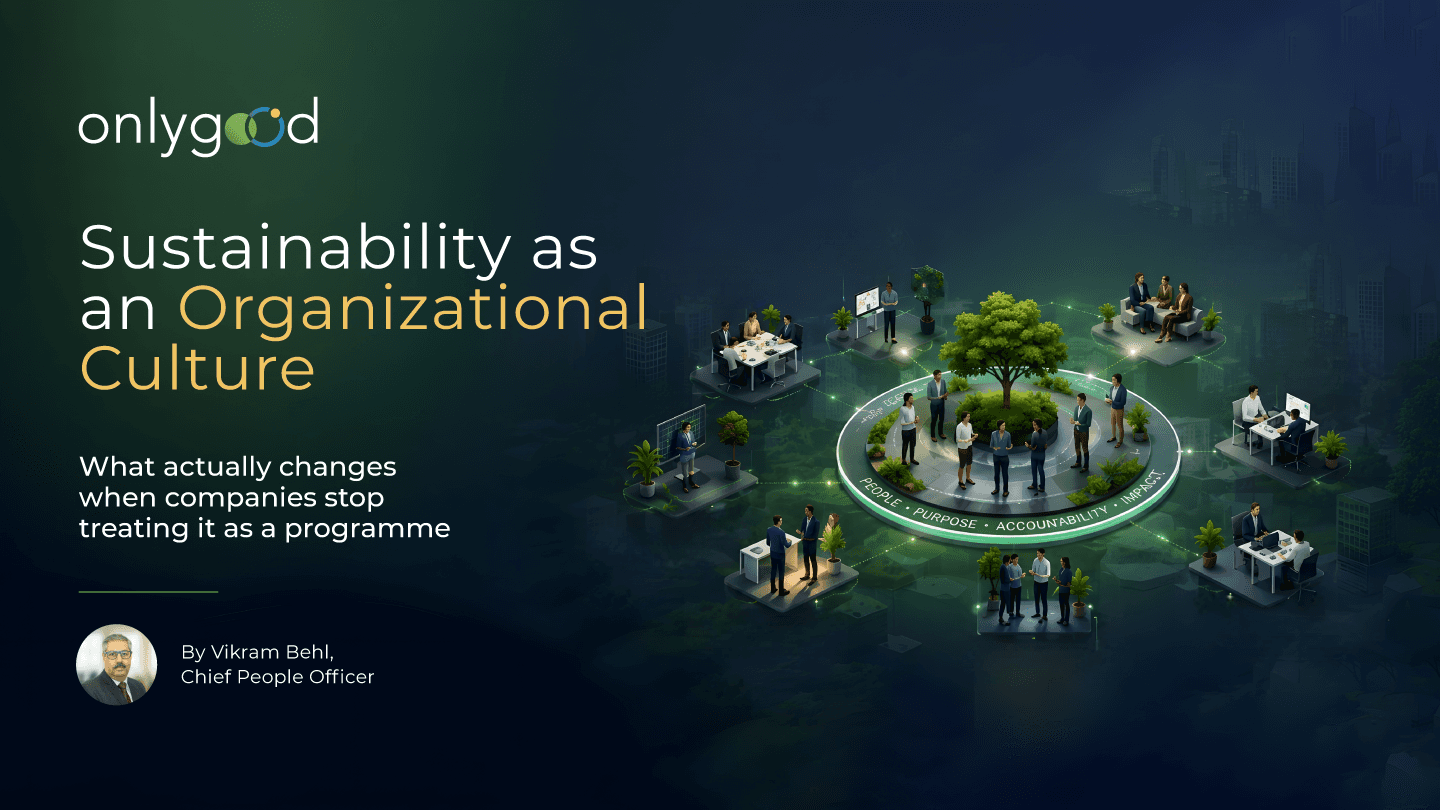
What actually changes when companies stop treating it as a programme?
Something has quietly shifted in how serious organizations are approaching sustainability.
It is no longer only a compliance matter or a reporting exercise. Increasingly, it is showing up in conversations about how companies hire, how they evaluate performance, how they communicate internally, and how they make decisions under pressure.
But there is a gap between organizations that have recognized this shift and organizations that have actually responded to it. That gap is cultural. And closing it is harder than most leadership teams expect not because the intention is missing, but because the systems underneath the culture haven't changed.
After working across industries and organizational environments a few patterns have become difficult to ignore. This blog is an attempt to put those observations into honest language.
Sustainability Stays Aspirational Until It Enters the Appraisal Room
There is a version of sustainability culture that lives in the values deck. It sounds right. It looks good in the annual report. Leadership mentions it at town halls. And then employees go back to their desks and get evaluated on revenue, delivery timelines, cost efficiency, and headcount productivity. Not one line item on how their decisions considered long-term impact.
This is not a criticism of organizations. It is an observation about how culture actually works.
People are intelligent. They pay close attention to what is being measured, what is being rewarded, and what leadership actually follows up on in quarterly reviews. Everything outside that system however sincerely communicated becomes ambient noise over time.
The shift that is beginning to happen in more forward-thinking organizations is the integration of sustainability indicators into performance conversations. Not just for the ESG team or the sustainability head. For procurement leads, business unit managers, and hiring decision-makers. It is early. It is imperfect in most places. But it represents a meaningful change in organizational logic from sustainability as a stated value to sustainability as an operational expectation.
“Until that shift happens in an organization's appraisal and accountability systems, the culture conversation is largely aspirational.”
The Problem Isn't Awareness. It's Authenticity
The pattern is familiar across many organizations.
Employees hear about sustainability at the annual town hall. There may be an Environment Day event, a green pledge initiative, or a sustainability week. And then, months later, a survey arrives in inboxes during reporting season asking about commute habits, paper usage, and energy consumption at home.
That is data collection. It is not a culture.
The more important observation is this: employees, particularly those who have joined organizations in the last five to seven years, are not waiting to be informed about sustainability. Many of them arrive with genuine awareness and, often, strong personal values on the subject. What they are looking for is whether the organization takes it as seriously as they do. They are watching whether sustainability comes up in business reviews or only in dedicated ESG meetings. They are noticing whether a procurement decision that prioritized ethical sourcing gets recognized or whether it gets questioned because it costs slightly more. They are paying attention to whether managers talk about these things as part of normal work, or only when a communication campaign is running.
The organizations getting internal sustainability communication right are treating it the same way they treat any other cultural priority consistently, across levels, embedded in the rhythm of business conversations, not isolated in calendar moments.
The shift from broadcasting sustainability to embedding it in everyday business language is small in design. The difference it makes to how employees perceive the organization's authenticity is not.
Psychological safety around sustainability is rarer than you think
This one deserves more honest discussion than it typically receives.
In most organizations, there is an employee who has at some point noticed something worth raising, a supplier practice that seemed inconsistent with stated values, a product claim that felt overstated, a business decision that quietly contradicted a public sustainability commitment.
In many cases, that employee stayed silent. Not because they lacked awareness or conviction. But because organizations carry unwritten rules about what kinds of questions are welcome and what kinds slow things down. Sustainability-related concerns especially when they create friction with a client relationship, a cost target, or a launch deadline frequently fall outside the acceptable zone.
Psychological safety in sustainability has a very specific meaning. It is not a general atmosphere of openness. It is whether someone can say, in a business meeting, "I think this conflicts with what we have committed to" and be taken seriously rather than being quietly labelled as someone who doesn't understand commercial reality.
What has changed in recent years is that more leadership teams are actively working to create that kind of environment. The approach that seems to work is not policy-driven. It is behavioral. When a senior leader visibly engages with a concern raised on sustainability grounds not deflecting it, not deprioritizing it, but genuinely working through it, it signals to the organization what is actually acceptable.
Psychological safety around sustainability is not built through a policy or a training module. It is built through a few consistent moments where speaking up was visibly respected.
The Real Test of Values Is Pressure, Not Policy
Customer centricity. Integrity. Collaboration. These are values most organizations share, in some form. They are also the right values for building a sustainable organization not because they sound good, but because sustained business relevance genuinely depends on them.
The harder conversation is what happens when these values are tested.
A key customer pushes back on an ethically sourced input because it affects their margins. A cross-functional sustainability initiative loses momentum because three departments have conflicting quarterly priorities. A product launch timeline creates pressure to deprioritize a supplier audit. These are not failures of intention. They are the moments where culture is either built or quietly eroded.
What is genuinely encouraging is that more leadership teams are now willing to have these conversations openly. ESG is no longer only a reporting consideration, it is showing up in investor conversations, client RFPs, and talent decisions in ways that were not common five years ago. That external accountability has created more internal permission to ask difficult questions honestly.
Customer centricity, viewed through a sustainability lens, means building trust across a relationship not optimizing for the next transaction. Integrity means that public commitments and internal decisions are roughly aligned. Collaboration means that sustainability challenges, which are inherently cross-functional and often cross-organizational, are treated as shared problems rather than delegated to a single function.
These values are not being redefined. They are simply being held to a higher standard and that is exactly what pressure is supposed to do.
The Next Leaders Will Be Defined by Culture, Not Compliance
The organizations that will build genuine sustainability culture over the next five to seven years will likely not be the ones with the most sophisticated ESG reports. They will be the ones where sustainability thinking has entered the everyday fabric, how people are evaluated, how internal concerns are handled, how values hold under commercial pressure.
This is fundamentally a people and culture challenge. The People function has a larger and more structural role to play in this space than it currently occupies in most organizations. Not as the team that runs sustainability engagement programmes, but as the function that shapes the systems - appraisal, communication, capability, and accountability through which culture is actually built.
Organizations that treat this as an HR agenda will stay behind. Organizations that treat it as a business design challenge will pull ahead. The difference between the two is not ambition. It is where sustainability sits in the systems that govern how people actually work every day.