ESG strategies often begin with strong intent.
Organizations define sustainability goals, publish commitments, and align with global frameworks. But when it comes to execution, especially across large, complex supply chains, intent alone is not enough.
The real challenge lies in answering a fundamental question:
How do you evaluate and compare the ESG performance of your suppliers at scale?
Because that is where the majority of ESG exposure sits.
Across industries, supply chains account for:
The largest share of greenhouse gas emissions (Scope 3)
The highest concentration of human rights and labor risks
The most complex and least visible operational dependencies
And yet, many organizations still lack a structured way to measure and compare supplier performance consistently.
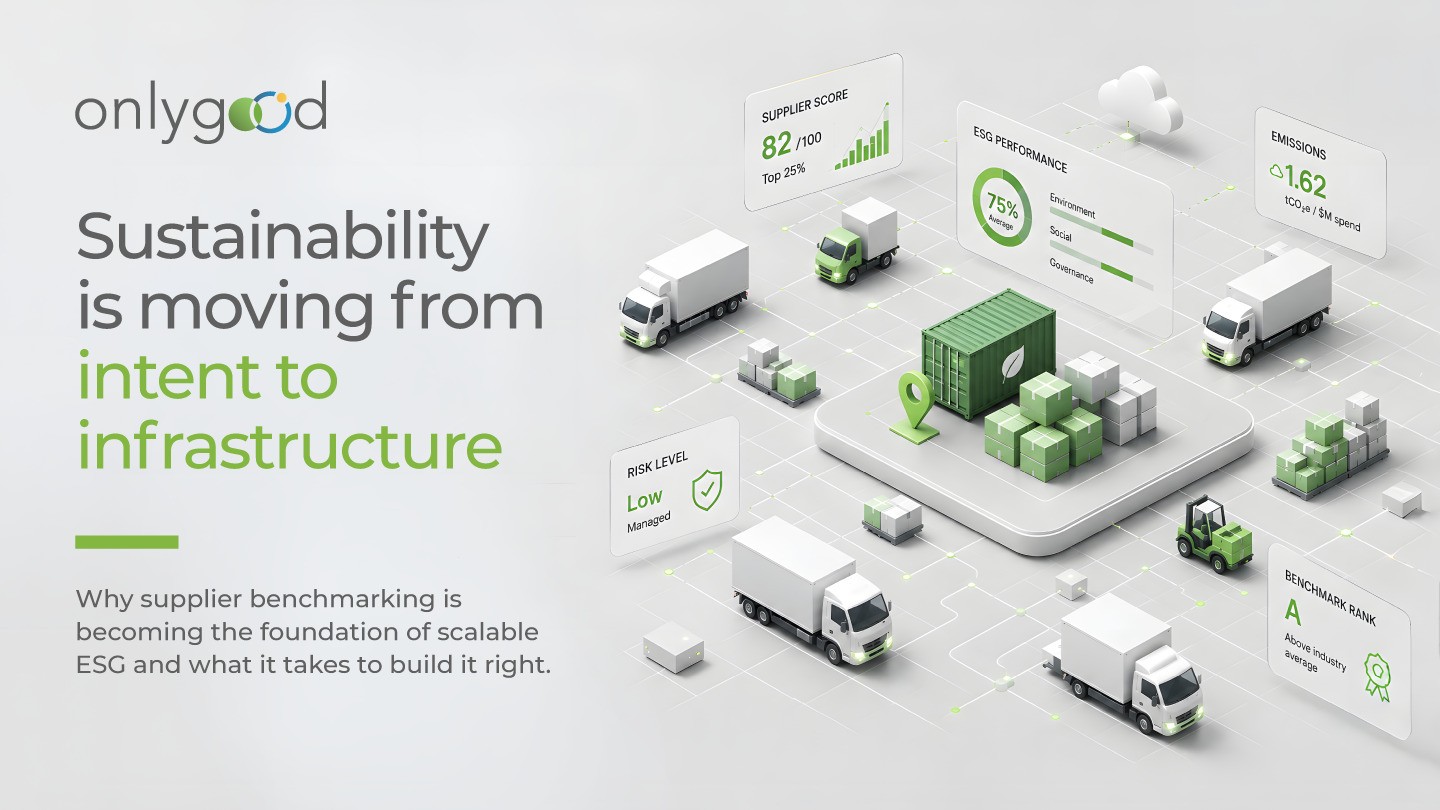
This is where supplier benchmarking and ratings become critical. Not as a reporting mechanism but as the foundation of a scalable, decision-driven ESG strategy.
What is Supplier Benchmarking?
Supplier benchmarking is the process of evaluating suppliers against a standardized set of ESG criteria and comparing their performance across a common framework.
In practical terms, it means:
Defining what “good ESG performance” looks like
Collecting comparable data from suppliers
Converting that data into scores or ratings
Using those insights to inform decisions
It moves organizations from:
Individual assessments
toRelative performance visibility
Because ESG data without context has limited value.
A supplier’s emissions data, for example, only becomes meaningful when compared to:
Industry peers
Category averages
Internal benchmarks
Benchmarking provides that context.
Why Supplier Benchmarking is No Longer Optional
As ESG expectations evolve, supplier benchmarking is shifting from a best practice to a necessity.
1. It Brings ESG into Procurement Decisions
Procurement has traditionally focused on cost, quality, and delivery.
But ESG introduces a fourth dimension: Sustainability performance
Without benchmarking:
ESG remains disconnected from sourcing decisions
With benchmarking:
Suppliers can be compared based on ESG performance
Trade-offs between cost and sustainability become visible
Procurement becomes a driver of ESG outcomes
This is particularly critical in areas like Scope 3 emissions, where supplier selection directly impacts organizational footprints.
2. It Enables Risk Identification and Management
Most ESG risks are not evenly distributed.
They are concentrated in:
Certain geographies
Specific industries
Particular supplier segments
Benchmarking allows organizations to:
Identify high-risk suppliers
Prioritize due diligence efforts
Focus resources where impact is highest
Instead of treating all suppliers equally, organizations can adopt a risk-based approach.
3. It Strengthens Accountability Across the Supply Chain
Many organizations have supplier codes of conduct.
But codes alone do not ensure compliance.
Benchmarking introduces:
Measurable expectations
Transparent performance indicators
Comparable results across suppliers
It answers critical questions:
Which suppliers meet ESG standards?
Which do not?
What actions have been taken?
This shifts ESG from policy → to accountability and follow-through.
4. It Supports Regulatory and Reporting Requirements
Regulatory frameworks are increasingly focused on:
Supply chain due diligence
ESG data transparency
Evidence of action and remediation
Organizations are expected to:
Map supplier risks
Monitor performance continuously
Demonstrate corrective actions
Benchmarking provides the structured data and comparability required to meet these expectations.
5. It Enables Measurable Improvement
The purpose of benchmarking is not just to evaluate suppliers.
It is to improve them.
By comparing performance across time and peers, organizations can:
Track progress
Identify recurring issues
Measure the effectiveness of interventions
This turns ESG from a static assessment into a continuous improvement cycle.
How to Implement Supplier Benchmarking Effectively
While the concept is straightforward, implementation requires structure and discipline.
A robust benchmarking approach typically follows seven key steps.
Step 1: Define ESG Criteria and Metrics
Start by establishing what you want to measure.
This typically includes:
Environmental
Emissions data (Scope 1, 2, 3)
Energy and resource use
Waste and water management
Social
Labor practices
Human rights compliance
Health and safety standards
Governance
Business ethics
Compliance systems
Policies and certifications
The key is consistency.
All suppliers should be evaluated using the same framework.
Step 2: Collect Standardized Data
Data collection can be done through:
Supplier questionnaires
ESG platforms
Third-party assessments
Public disclosures
The focus should be on:
Structured data formats
Comparable inputs
Verifiable information
Inconsistent data leads to unreliable benchmarking.
Step 3: Score and Rate Suppliers
Convert collected data into:
Quantitative scores (e.g., 0–100)
Risk categories (low, medium, high)
Performance tiers
This enables:
Easy comparison
Clear communication
Decision-ready insights
Step 4: Segment Suppliers Strategically
Not all suppliers require the same level of scrutiny.
Segment suppliers based on:
Spend value
Risk exposure
Strategic importance
This ensures that:
High-risk, high-impact suppliers receive greater focus
Resources are used efficiently
Step 5: Benchmark and Analyze Performance
Once data is structured and scored, benchmarking begins.
Organizations can:
Compare suppliers within categories
Identify top and bottom performers
Analyze trends across geographies and industries
This is where insights become actionable.
Step 6: Drive Action and Improvement
This is the most critical step and the one most often overlooked.
Benchmarking must lead to:
Corrective action plans
Supplier engagement programs
Defined timelines for improvement
Escalation mechanisms for non-compliance
Without action, benchmarking remains an analytical exercise.
Step 7: Monitor Continuously
Supplier performance is dynamic.
Organizations must:
Update data regularly
Reassess suppliers periodically
Track improvements over time
Continuous monitoring ensures that benchmarking remains relevant and effective.
What Good Benchmarking Looks Like
An effective supplier benchmarking system is:
Standardized – Consistent criteria across suppliers
Comparable – Clear scoring and ranking
Dynamic – Updated regularly
Action-oriented – Linked to decisions and improvements
It is not a one-time exercise.
It is an ongoing capability embedded into procurement and ESG systems.
Common Pitfalls to Avoid
Despite its importance, many organizations struggle with execution.
Common challenges include:
One-Time Assessments
Conducting ESG assessments only during onboarding creates outdated insights.
Overly Complex Frameworks
Too many metrics can:
Overwhelm suppliers
Reduce response quality
Complicate analysis
Lack of Integration
Benchmarking data is often not used in:
Procurement decisions
Supplier selection
Contract management
No Follow-Through
Identifying risks without addressing them creates:
Compliance gaps
Reputational risks
From Ratings to Real Impact
Supplier ratings are often seen as the final output.
In reality, they are just the beginning.
The real value lies in how organizations use these insights to:
Make better sourcing decisions
Engage suppliers effectively
Reduce risk and improve performance over time
This is what transforms ESG from a reporting function into an operational capability.
The Role of Technology and Systems
Managing supplier benchmarking manually is not sustainable especially at scale.
Organizations dealing with:
Hundreds or thousands of suppliers
Multiple geographies
Diverse regulatory requirements
Need systems that enable:
Automated data collection
Standardized assessments
Real-time monitoring
Centralized visibility
Without this, benchmarking remains fragmented.
With it, it becomes a core part of business intelligence.
The Onlygood Perspective
Under the approach shaped at Onlygood, supplier benchmarking is not treated as a standalone activity.
It is embedded into a broader ESG intelligence system one that connects supplier data, risk visibility, and decision-making in real time.
This means:
Moving from one-time assessments to continuous monitoring
Standardizing ESG data across the supply chain
Integrating supplier performance into procurement decisions
Enabling organizations to act on insights not just report them
At its core, the focus is on making sustainability:
Simple to understand
Smart in execution
Actionable at scale
Because the real challenge is turning that data into clarity, confidence, and measurable progress.
Conclusion: The Foundation of Scalable ESG
As ESG expectations continue to grow, the effectiveness of any strategy will depend on how well organizations manage their supply chains.
And that begins with a simple but powerful capability:
The ability to benchmark supplier performance consistently and continuously.
Because:
You cannot manage what you cannot measure
You cannot compare what you do not standardize
And you cannot improve what you do not track over time
Supplier benchmarking is the backbone of scalable ESG execution.
The future of ESG will be defined not by the strength of commitments but by the systems that support them. Systems that allow organizations to see clearly, act decisively, and improve continuously.
Evolving businesses for a better tomorrow.