ECHA's proposed universal PFAS restriction covers around 10,000 substances and is already influencing supplier expectations across European supply chains. This article explores what is at stake for Indian companies, who is most exposed, and how businesses are preparing for the transition.
DIRECT ANSWER
Indian specialty chemical and automotive component suppliers should complete a Phase 1 PFAS substance inventory before Q4 2026. This is a substance-level list of all per- and polyfluoroalkyl substances (PFAS) used in their products and manufacturing processes. While the regulatory deadline is still some time away, European OEMs such as BMW Group, Stellantis, and Mercedes-Benz have already started asking suppliers to disclose PFAS as part of their qualification process. Companies that cannot provide this information are increasingly finding themselves at a disadvantage in new business discussions.
Rajeev Sinha
CXO, Onlygood FutureTech | Sustainability Intelligence for Supply Chain Professionals
Rajeev writes weekly on the regulatory and commercial forces reshaping Indian manufacturing and supply chains. The Onlygood Signal is read by supply chain and sustainability professionals across automotive, specialty chemicals, and packaging.
What Is the ECHA Universal PFAS Restriction and Why Does It Matter to India?
In February 2023, five European Union member states - Germany, the Netherlands, Norway, Sweden, and Denmark - jointly submitted a proposal to the European Chemicals Agency (ECHA) to restrict per- and polyfluoroalkyl substances (PFAS) as an entire chemical class. The proposal does not target a single compound or a handful of chemicals. It covers all PFAS which includes around 10,000 substances.
The scale of this proposal is unprecedented. It is the largest chemical restriction ever proposed in European regulatory history. For comparison, the landmark REACH Annex XVII restriction on PFOA and related compounds covered fewer than 30 substances. By contrast, the proposed PFAS restriction applies to virtually all substances containing a carbon-fluorine bond, unless their use can be demonstrated to be essential.
KEY REGULATORY FACTS
10,000+ substances covered. Restriction proposal submitted February 2023. EC decision expected 2025 to 2026. Sector transition periods: 1.5 years (where alternatives exist) to 12 years (critical uses with no alternative). Automotive transition period: expected 5 to 7 years from restriction date.
The restriction is currently moving through ECHA's Risk Assessment Committee (RAC) and Socio-Economic Analysis Committee (SEAC) review. A European Commission decision is expected in the 2025 to 2026 timeframe. When the restriction applies, it will affect the manufacture, use, and placing on the EU market of PFAS-containing products across all sectors including products manufactured outside the EU and exported into it.
That final clause is the one Indian suppliers need to read carefully. A restriction on the EU market does not stay inside Europe. It travels through OEM supply chains directly into supplier qualification requirements, RFQ documentation, and approved supplier lists regardless of where those suppliers are located.
Source: ECHA. "Universal PFAS Restriction Proposal." European Chemicals Agency. February 2023. echa.europa.eu
The Regulatory Timeline: Where Are We Now?
Feb 2023
Restriction Proposal Submitted
Five EU member states submit universal PFAS restrictions to ECHA. Public consultation launched.
Sep 2023
Public Consultation Closes
Over 5,600 responses received from industry, NGOs, governments, and research bodies - the most in ECHA history for a single restriction.
2024–2025
RAC and SEAC Committee Opinions
ECHA's scientific committees review the restriction dossier and publish opinions on risk and socioeconomic impact.
2025–2026
European Commission Decision Expected
The EC adopts the restriction under REACH Annex XVII. Sector-specific transition periods begin from this date.
2027 onward
Restriction Applies — OEM Compliance Active
First transition deadlines apply. OEM approved supplier lists already filtered for PFAS compliance well before this date. Companies without documentation are excluded from new business awards.
2030–2035
Transition Periods End
Industrial and automotive transition periods close. All PFAS use in scope must either have an approved essential use derogation or be replaced.
Which Indian Companies Are Most Exposed?
India is one of the world's leading producers of fluorochemicals and fluoropolymers. That has helped establish a strong position in global specialty chemicals. It also means Indian manufacturers are likely to be among those most affected by the proposed EU restrictions on PFAS.
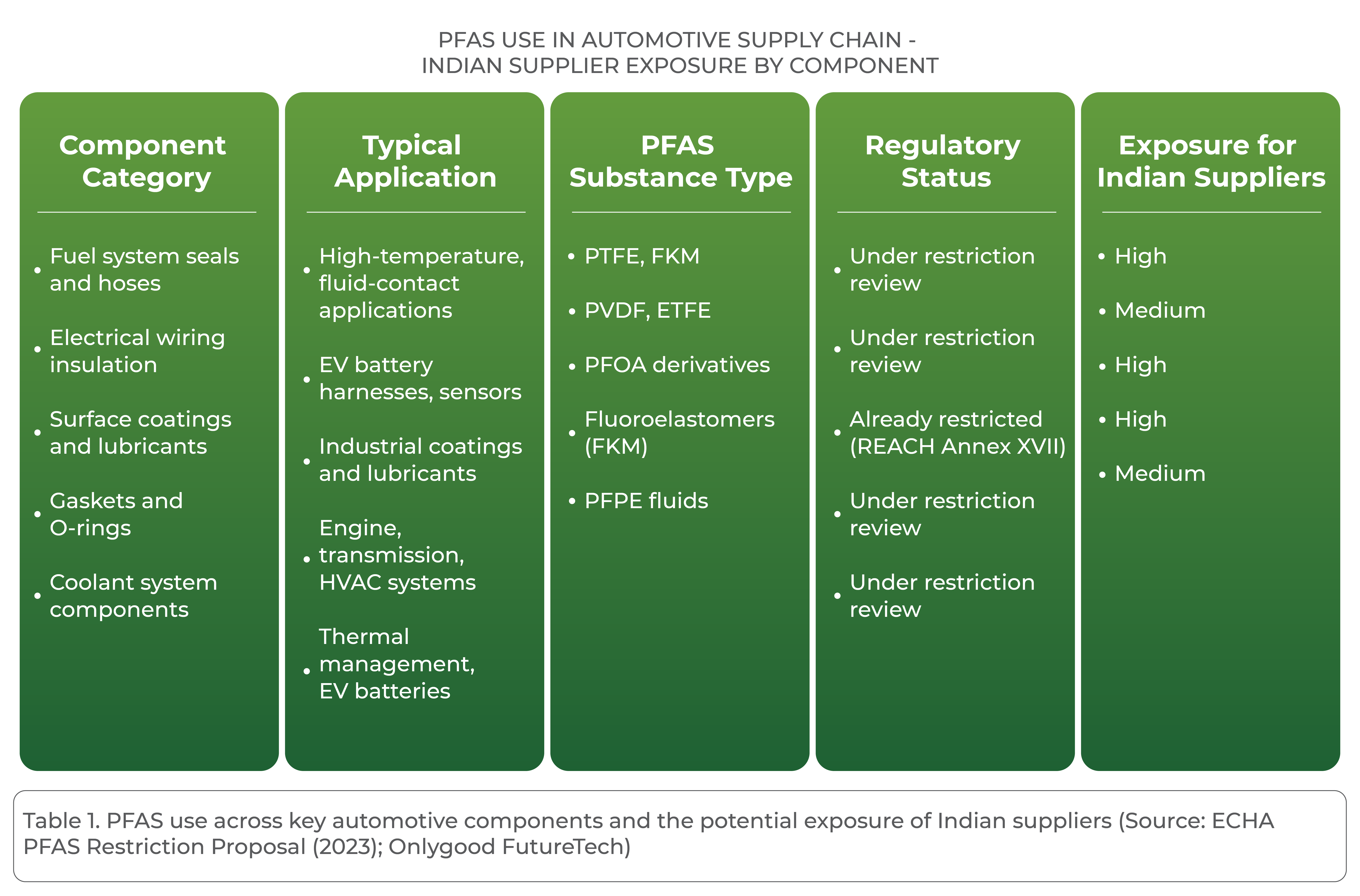
Where the Exposure Lies?
Among Indian fluorochemical manufacturers, the level of exposure varies depending on product mix and end-use markets.
SRF Limited, India's largest integrated fluorochemicals company, manufactures refrigerants, specialty chemicals, and fluoropolymers. Its FY2024 Annual Report highlights ongoing investments in alternative chemistries, including research on fluoropolymer substitutes and short-chain alternatives. This suggests the company is preparing for a changing regulatory landscape.
Gujarat Fluorochemicals Limited (INOX Fluorine) is one of India's largest producers of PTFE and other fluoropolymers. Given the nature of its portfolio, the company has one of the highest levels of direct PFAS exposure among Indian manufacturers. Based on publicly available disclosures, it has not yet outlined a formal strategy for responding to the proposed PFAS restrictions.
Navin Fluorine International operates across pharmaceutical, agrochemical, and industrial fluorine chemistry. Its exposure is more diversified than that of SRF or Gujarat Fluorochemicals, although PFAS-related products remain part of its industrial chemicals portfolio.
The implications extend well beyond fluorochemical manufacturers. India's automotive component industry is also exposed because of its integration with European supply chains. According to the Automotive Component Manufacturers Association (ACMA), the industry recorded a turnover of USD 19.4 billion in FY2022–23, including exports worth USD 4.2 billion. A significant share of these exports supplies European OEMs—the same customers that are increasingly seeking PFAS disclosures from suppliers during qualification and procurement.
Sources: SRF Limited Annual Report FY2024 | GFL Annual Report FY2024 | Navin Fluorine Annual Report FY2024 | ACMA Indian Automotive Component Industry Annual Report 2022-23
What European OEMs Are Doing Right Now
The OEM moves on PFAS are not waiting for the European Commission decision. They are happening now, at the supplier qualification level, driven by each OEM's own product development timelines and brand risk management.
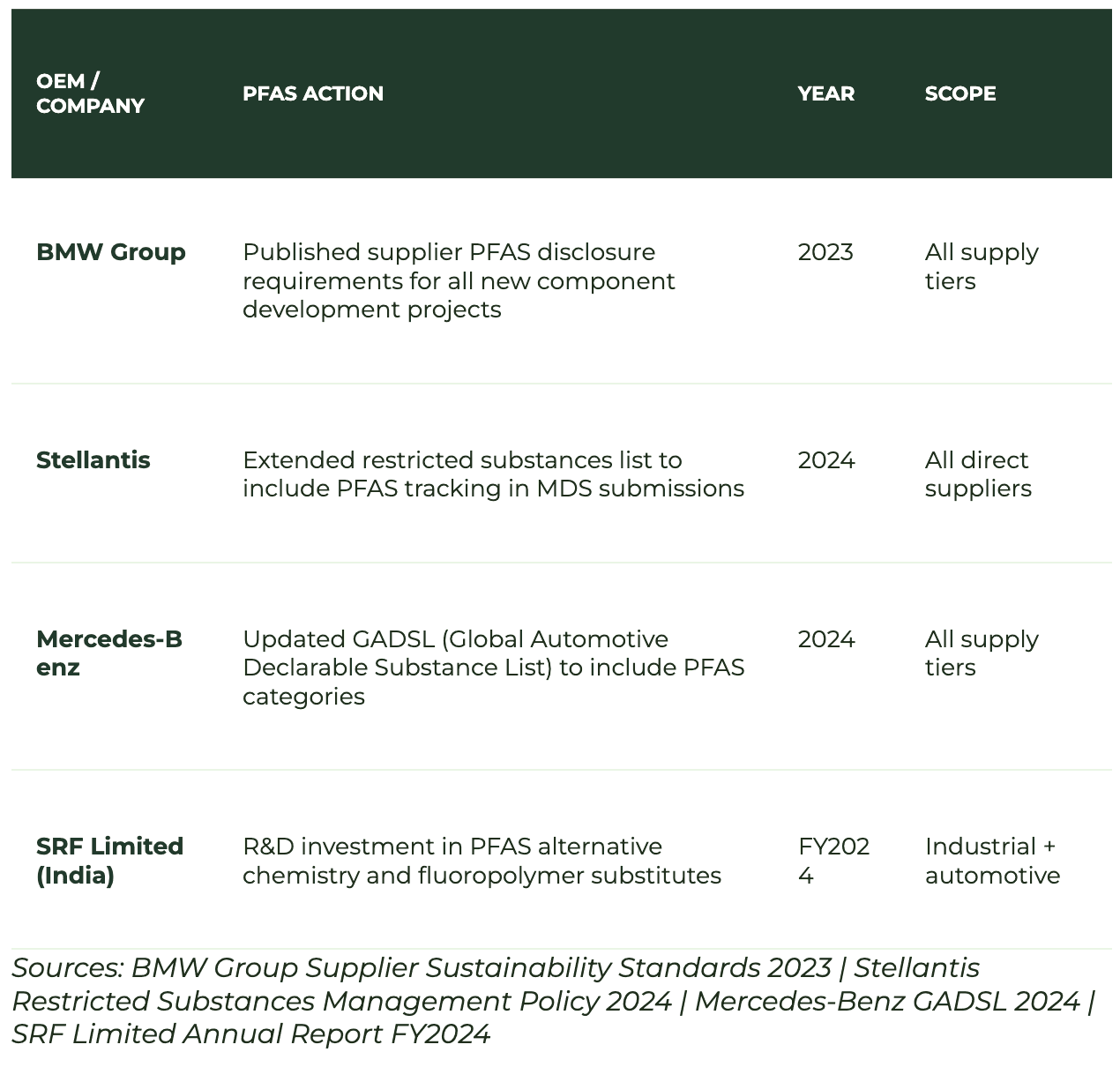
Non-compliance with MDS declarations at Stellantis and Mercedes-Benz is now a disqualification trigger in new business awards. This is not a future risk. It is a current commercial reality for every Indian auto component supplier that exports to Europe or supplies European-aligned Tier 1 companies in India.
A Three-Phase Roadmap for Indian Suppliers
For many Indian suppliers, the challenge is not knowing what needs to be done, but where to begin. The transition does not have to happen all at once. In practice, it can be approached in three phases, with each stage building on the previous one.
Phase 1 (Weeks 1–6): Build a PFAS Substance Inventory
The first step is to create a comprehensive inventory of PFAS used across products and manufacturing processes. This involves reviewing product formulations, process chemicals, and supplier Safety Data Sheets (SDS) to identify fluorine-containing substances.
The output should be a substance-level inventory that includes CAS numbers, use functions, volumes, and product-line mapping. Increasingly, this is one of the first documents OEM procurement teams ask suppliers to provide. For a mid-sized company with well-organised product data, this exercise can typically be completed within four to six weeks.
Phase 2 (Months 2–4): Gather Supplier Declarations
Once the internal inventory is complete, the next step is to engage upstream suppliers and obtain PFAS declarations for every input material.
This helps identify gaps in visibility across the supply chain. For example, if a supplier cannot confirm whether a gasket compound contains fluoroelastomers, that uncertainty is likely to surface later during customer qualification or compliance reviews. Incorporating PFAS declarations into the annual supplier assessment process can help establish a more reliable and repeatable approach.
Over time, supplier PFAS declarations should become part of the standard annual supplier assessment process, helping build a more transparent and resilient supply chain.
Phase 3 (Months 4–12): Develop a Reformulation Roadmap
The inventory and supplier declarations together provide the basis for assessing exposure across the product portfolio. Products can then be grouped into exposure tiers:
Tier 1: Direct PFAS manufacturers
Tier 2: Products containing PFAS-based materials
Tier 3: Indirect PFAS use or exposure through processing aids
For Tier 1 and Tier 2 products, companies can begin evaluating alternative chemistries while developing implementation timelines and capital investment estimates. Not every product will require immediate reformulation, but establishing a clear roadmap helps organisations prioritise resources and prepare for future regulatory requirements.
Why Acting Early Matters?
Companies that can provide a documented PFAS inventory are often better positioned during supplier qualification discussions with OEMs. While the proposed EU restrictions are still moving through the regulatory process, many customers have already begun requesting greater transparency from their suppliers. Preparing early is therefore becoming less about regulatory compliance alone and more about maintaining access to global supply chains.
——
Frequently Asked Questions
What is the ECHA universal PFAS restriction and when does it apply?
The ECHA universal PFAS restriction is a proposed regulation covering approximately 10,000 per- and polyfluoroalkyl substances, submitted in February 2023 by five EU member states.
A European Commission decision is expected in 2025 to 2026, with sector-specific
transition periods from 1.5 to 12 years. For automotive applications, the transition window is expected to be 5 to 7 years from the restriction date, placing effective compliance deadlines between 2030 and 2032 for most industrial uses. However, OEM supplier qualification requirements are being updated ahead of the legal deadline, meaning commercial pressure is arriving now.
Which Indian specialty chemical companies are most exposed to the PFAS restriction?
SRF Limited, Gujarat Fluorochemicals Limited (INOX Fluorine), and Navin Fluorine International are the Indian companies with the highest direct PFAS exposure.
SRF is already investing in alternative chemistry. GFL has high exposure through its PTFE and fluoropolymer portfolio without a published response strategy as of FY2024. Auto component manufacturers using PFAS-containing seals, coatings, and hoses in production are Tier 2 exposure and need to complete a PFAS inventory and prepare OEM compliance documentation before Q4 2026.
Do Indian companies need to comply with ECHA PFAS restrictions if they are not based in Europe?
Yes, if their products or materials enter the EU market directly or through European OEM supply chains.
The restriction applies to substances placed on the EU market. Indian suppliers to European OEMs — directly or through European Tier 1 intermediaries — are in scope for their European-market products. Additionally, OEM procurement teams are applying PFAS standards globally to their entire supply chains, not just to EU-destined products. Indian suppliers should expect global application of these standards regardless of the formal legal scope.
What is a PFAS substance inventory and how long does it take to build?
A PFAS substance inventory is a list of all per- and polyfluoroalkyl substances present in a company's products and manufacturing processes, with CAS numbers, use functions, and volume.
It is built by reviewing product formulations, process chemicals, and supplier material safety data sheets (SDS) for fluorine-containing substances. A mid-size specialty chemical or auto component company with organised product data can complete Phase 1 in four to six weeks. The output is a document that directly answers OEM supplier qualification questions on PFAS. Most Indian companies have not started this process.
Which European OEMs are currently requiring PFAS compliance from Indian suppliers?
BMW Group, Stellantis, and Mercedes-Benz have all incorporated PFAS requirements into their supplier qualification and MDS submission processes as of 2023 to 2024.
BMW Group published supplier PFAS disclosure requirements in 2023 covering all supply tiers. Stellantis and Mercedes-Benz have incorporated PFAS tracking into their Material Data System (MDS) and GADSL (Global Automotive Declarable Substance List) requirements. Non-compliance is a disqualification trigger in new business awards at both Stellantis and Mercedes-Benz as of 2024. OEM qualification questionnaires across the sector are increasingly including PFAS inventory status as a scored evaluation criterion.
What PFAS alternatives are available for automotive applications?
Alternative chemistry varies by application. No single substitute covers all PFAS uses — a product-by-product assessment is required.
For fuel system seals and gaskets, silicone-based elastomers are viable in lower-temperature applications. HNBR (hydrogenated nitrile butadiene rubber) and EPDM are being qualified by OEMs for high-temperature seals. For wiring insulation, halogen-free thermoplastic elastomers and cross-linked polyolefins are being adopted as alternatives to PVDF and ETFE. For surface coatings, water-based and UV-cured coatings replace PTFE-based coatings in many applications. Each substitution requires application-level testing and OEM qualification approval.
How does the PFAS restriction relate to CAFE III compliance for Indian automotive suppliers?
CAFE III and the PFAS restriction are separate regulatory instruments but they converge on the same Indian supplier at the same time.
CAFE III targets India's domestic OEM fleet CO2 performance by April 2027. The PFAS restriction is a European-driven compliance requirement affecting exports and OEM supply chain qualification. Indian auto component manufacturers serving both domestic OEM CO2 compliance requirements and European export markets face simultaneous compliance demands. Companies that have invested in compliance infrastructure for CAFE III supplier data management, regulatory tracking, cross-functional teams are better positioned to also manage PFAS documentation efficiently.
——
References
ECHA. "Universal PFAS Restriction Proposal." European Chemicals Agency. February 2023. echa.europa.eu
BMW Group. "Supplier Sustainability Standards." 2023. bmwgroup.com
Stellantis. "Restricted Substances Management Policy." 2024. stellantis.com
Mercedes-Benz. "Global Automotive Declarable Substance List (GADSL)." 2024. mercedes-benz.com
SRF Limited. "Annual Report FY2024." srfindia.com
Gujarat Fluorochemicals Limited. "Annual Report FY2024." gfl.co.in
Navin Fluorine International. "Annual Report FY2024." navinfluorine.com
ACMA. "Indian Automotive Component Industry: Annual Report 2022-23." acma.in