Introduction
Manufacturing today sits at the centre of a rapidly shifting landscape. Regulatory expectations are expanding across geographies, supply chains are under increasing scrutiny, and customers both B2B and end consumers are demanding greater transparency and accountability.
What was once a peripheral concern has now moved firmly into the core of business decision-making.
In response, most manufacturers have begun engaging with sustainability in some form. But the path forward is rarely straightforward.
Sustainability adoption is not a linear checklist that can be completed and set aside. It is an evolving journey, one that typically begins with compliance, moves through operational and strategic integration, and ultimately leads to transformation at both the business and industry level.
Yet, despite growing efforts, a fundamental challenge persists.
Most manufacturers are already on this journey but very few have a clear understanding of where they stand today, how mature their efforts truly are, or what the next step should be.
Without this clarity, sustainability initiatives often remain fragmented driven by immediate requirements rather than long-term strategy.
This is where a structured maturity framework becomes critical.
At Onlygood, we work with organizations across this entire journey helping them move from fragmented compliance efforts to integrated, value-driven ESG systems. By combining data, technology, and expert-led insights, we enable businesses to assess their current maturity, identify the most impactful next steps, and build a clear roadmap that connects sustainability to both value creation and risk mitigation.
In this blog, we break down the five stages of the sustainability journey in manufacturing from compliance to transformation. We explore what defines each stage, what actions typically drive progress, and how organizations can move forward with greater clarity, confidence, and strategic intent.
The Sustainability Maturity Curve: From Compliance to Competitive Advantage
To navigate the complexity of sustainability, manufacturers need more than intent—they need a clear way to map progress and prioritize action.
This is where a structured maturity model becomes invaluable.
Rather than viewing sustainability as a set of disconnected initiatives, the maturity curve frames it as a progressive evolution of capability from reactive compliance to proactive value creation and, ultimately, industry leadership.
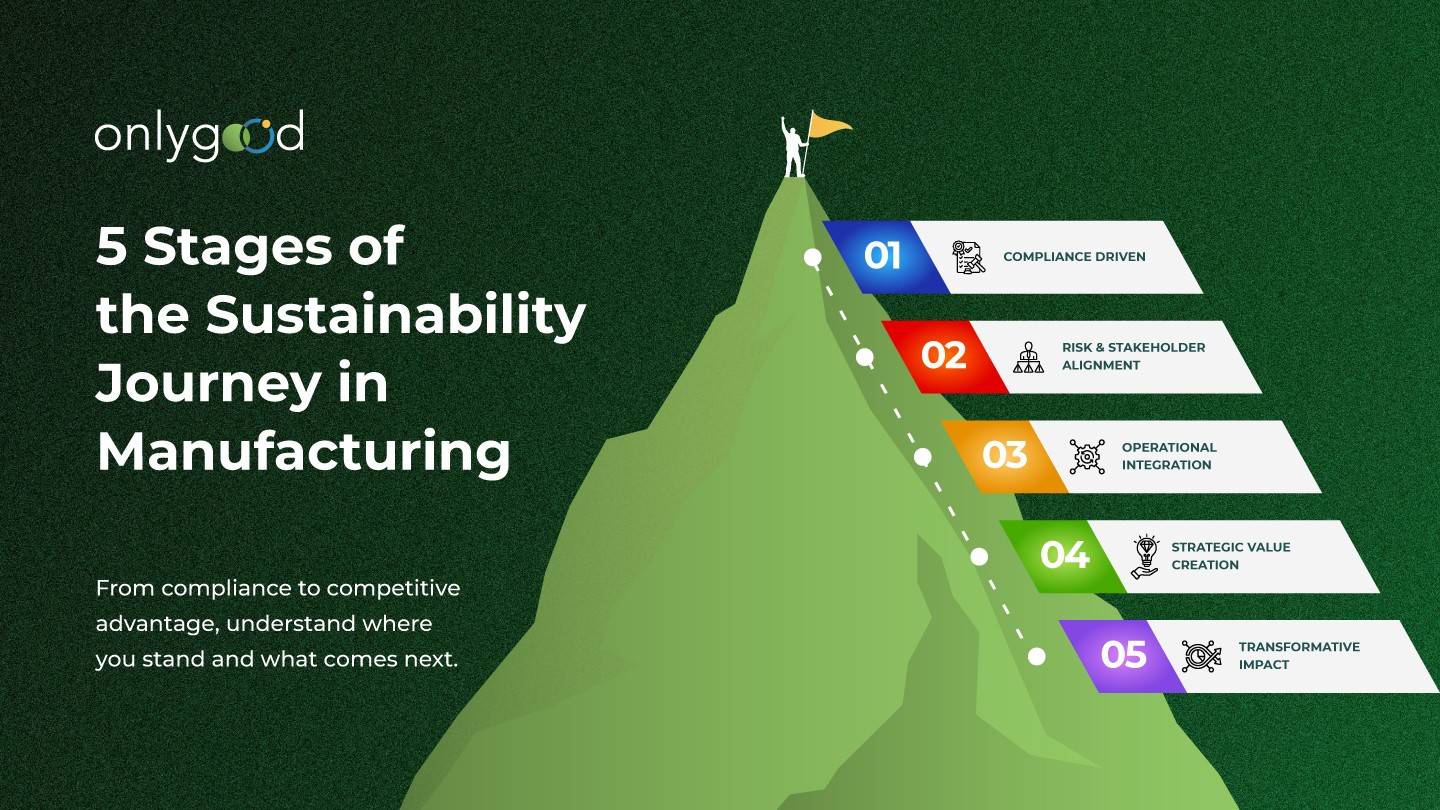
At its core, the sustainability journey in manufacturing can be understood across five distinct stages, each defined by a shift in mindset, capabilities, and business impact.
It begins with compliance, where the primary focus is on meeting regulatory requirements and avoiding penalties. As companies respond to growing pressure from investors, customers, and regulators, they move toward risk and stakeholder alignment, where sustainability becomes a tool for managing exposure and protecting reputation.
The journey then progresses into operational integration, where sustainability starts delivering tangible business benefits through efficiency gains, cost optimization, and improved resource management.
From there, leading organizations transition into strategic value creation, embedding sustainability into core business strategy driving innovation, unlocking new revenue streams, and building competitive differentiation.
At the highest level lies transformative impact, where companies go beyond their own operations to influence industry standards, reshape ecosystems, and drive systemic change.
This progression is not always linear. Companies may move back and forth between stages, or operate across multiple stages simultaneously in different parts of the business.
But the direction is clear.
The real shift happens when sustainability moves from being something companies report on to something they actively use to drive decisions, performance, and long-term growth.
In the sections that follow, we break down each of these five stages: what defines them, what actions are typical, and how manufacturers can move forward with clarity.
The Five Stages of the Sustainability Journey
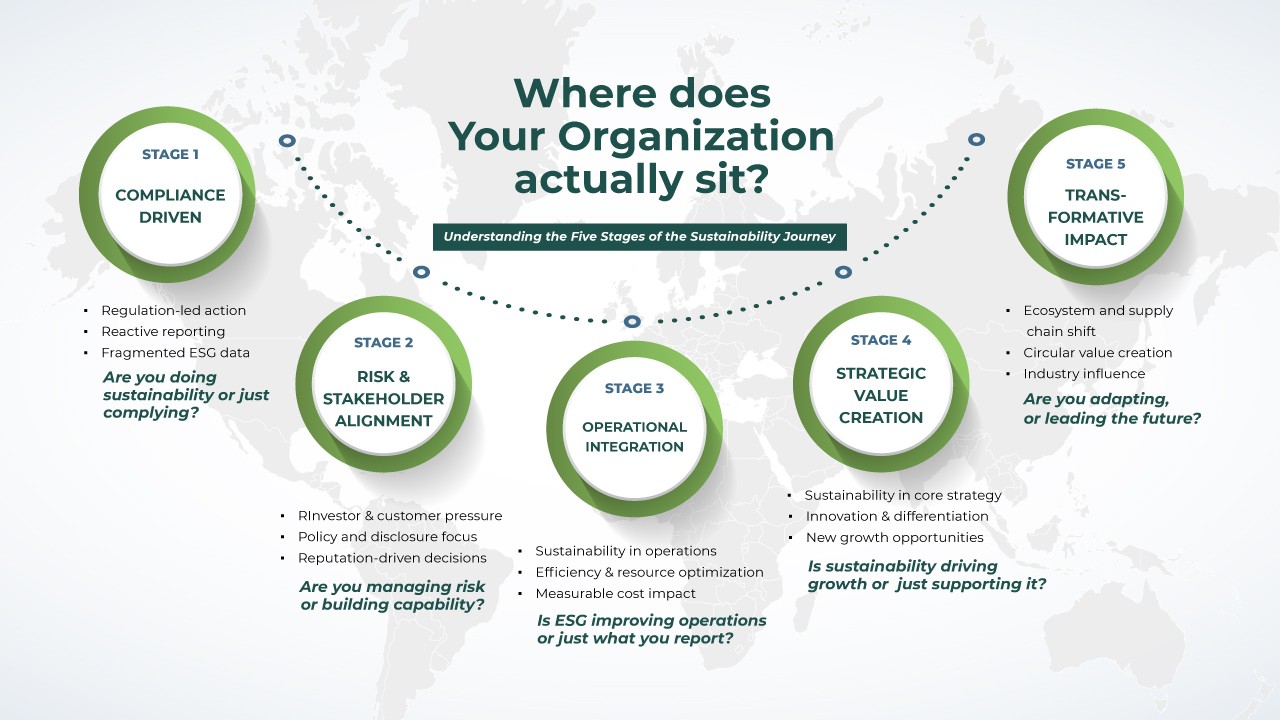
While every organization’s path is unique, most manufacturers progress through five distinct stages of sustainability maturity. Each stage reflects a shift in mindset, capabilities, and the role sustainability plays within the business.
Understanding these stages helps organizations identify where they are today and what it takes to move forward.
Stage 1: Compliance-Driven Sustainability
Mindset: “What do we need to do to stay compliant?”
At this stage, sustainability is primarily driven by regulatory requirements and disclosure obligations. Companies focus on meeting mandatory standards, filing reports, and avoiding penalties.
ESG is often treated as a cost centre, with limited internal alignment. Data collection is manual, fragmented, and largely reactive often driven by external deadlines rather than internal strategy.
Typical characteristics:
Focus on regulatory compliance (BRSR, GRI, CDP, etc.)
Siloed data collection across teams
Limited leadership involvement
ESG seen as an obligation, not an opportunity
Sustainability here is reactive driven by “must-do” requirements rather than business intent.
Stage 2: Risk & Stakeholder Alignment
Mindset: “What risks do we need to manage?”
As external pressure increases, companies begin responding to investors, customers, and supply chain partners. The focus shifts toward managing reputational, regulatory, and operational risks.
Organizations start formalizing ESG policies, improving disclosures, and aligning with stakeholder expectations. However, efforts are still largely defensive and fragmented.
Typical characteristics:
Increased focus on ESG ratings and investor expectations
Initial policy frameworks and governance structures
Efforts to reduce reputational and compliance risks
Expanded but still disconnected reporting processes
Companies begin to act but primarily to protect value, not create it.
Stage 3: Operational Integration
Mindset: “How can sustainability improve efficiency?”
This stage marks a critical turning point.
Sustainability moves into core operations, with organizations embedding ESG metrics into day-to-day decision-making. The focus is on efficiency, cost reduction, and process optimization.
Initiatives such as energy efficiency, waste reduction, and resource optimization begin delivering measurable financial impact.
Typical characteristics:
Integration of ESG metrics into operations
Energy, water, and waste optimization initiatives
Early use of data systems for tracking performance
Cross-functional collaboration begins to improve
This is where ESG starts proving its business case through tangible cost and efficiency gains.
Stage 4: Strategic Value Creation
Mindset: “How can sustainability drive growth and differentiation?”
At this stage, sustainability becomes a core component of business strategy.
Organizations move beyond efficiency and begin leveraging ESG to drive innovation, new revenue streams, and competitive advantage. Product design, customer offerings, and market positioning increasingly reflect sustainability priorities.
Typical characteristics:
Development of sustainable products and services
ESG integrated into long-term business strategy
Strong leadership alignment and governance
Clear link between sustainability and revenue growth
Sustainability shifts from operational improvement to strategic advantage.
Stage 5: Transformative Impact
Mindset: “How do we shape the future of our industry?”
At the highest level of maturity, companies go beyond internal transformation to drive systemic change across the ecosystem.
They influence industry standards, supply chains, policy frameworks, and consumer behaviour, positioning themselves as leaders in sustainability.
Typical characteristics:
Industry leadership and advocacy
Deep supply chain transformation (circularity, transparency)
Collaboration with policymakers and ecosystems
Sustainability embedded into organizational purpose
What Triggers Progress Across the Sustainability Journey
While the five stages provide a clear view of where organizations are, an equally important question remains:
What actually drives movement from one stage to the next?
For most manufacturers, the sustainability journey does not begin with strategy.
It begins with external pressure.
The Catalysts: Why Companies Start
The initial push toward sustainability is typically triggered by a combination of forces:
Regulatory mandates: Expanding disclosure requirements such as BRSR, global reporting standards, and climate regulations compel companies to act.
Investor expectations: ESG performance is increasingly tied to access to capital, valuations, and long-term investment decisions.
Customer and supply chain pressure: OEMs and global buyers now expect suppliers to meet defined sustainability benchmarks.
Reputational risk: Increased public scrutiny means that ESG failures can quickly translate into brand and business impact.
The First Steps: Where the Journey Begins
Once triggered, most organizations start with a familiar set of foundational actions:
Measuring impact: Establishing a baseline across key metrics such as carbon emissions, energy consumption, water usage, and waste generation.
Quick-win initiatives: Implementing low-cost, high-impact improvements like:
Switching to LED lighting
Optimizing logistics and fuel usage
Introducing basic recycling and waste management systems
Setting public targets: Announcing commitments such as:
Net Zero timelines
Renewable energy adoption goals
Waste reduction targets
These early actions are critical; they create momentum, demonstrate intent, and begin building internal awareness.
From Activity to Capability
However, a pattern quickly emerges.
Many companies initiate multiple sustainability efforts, but struggle to connect them into a cohesive system. Initiatives remain scattered across departments, data is inconsistent, and progress is difficult to measure in a structured way.
This is where the real shift begins.
Progression across stages is not driven by doing more activities it is driven by building capability:
The ability to measure consistently
The ability to integrate data across functions
The ability to link sustainability actions to business outcomes
What Changes Inside the Organization
As manufacturers progress along the sustainability journey, the most meaningful transformation does not happen at the surface level of initiatives, it happens within the organization itself.
Sustainability begins to reshape how companies operate, make decisions, and create value. This shift typically plays out across three critical dimensions: operations, technology, and culture.
Operational Transformation: From Efficiency to Resilience
At the operational level, sustainability moves from isolated improvements to system-wide optimization.
Early efforts such as energy efficiency and waste reduction evolve into deeper changes across production processes and supply chains.
Key shifts include:
Moving from linear to circular supply chains (reuse, recycling, take-back models)
Embedding resource efficiency into production planning
Adopting sustainable sourcing practices and supplier assessments
Redesigning processes to reduce emissions, waste, and resource intensity
Operations shift from cost optimization alone to balancing efficiency with long-term resilience.
Technology & Data: Building the ESG Intelligence Layer
As complexity grows, managing sustainability without robust data systems becomes impossible.
Organizations begin investing in technology and data infrastructure to track, measure, and manage ESG performance in a structured way.
Key shifts include:
Moving from spreadsheets to centralized ESG data platforms
Using analytics and automation to track performance in real time
Integrating ESG data across functions finance, procurement, operations
Enhancing auditability and traceability of disclosures
Data becomes the backbone of ESG maturity enabling visibility, consistency, and better decision-making.
Culture & Governance: Embedding Sustainability into the DNA
Perhaps the most critical and most challenging shift is cultural.
Sustainability can only scale when it is owned beyond a single team and embedded across leadership and the wider organization.
Key shifts include:
Stronger leadership alignment and board-level oversight
Employee engagement, training, and accountability mechanisms
Integration of ESG metrics into performance and incentive structures
Adoption of forward-looking practices such as internal carbon pricing (as seen in companies like Mahindra & Mahindra)
Without cultural integration, sustainability remains an initiative. With it, it becomes a business capability.
Across these three dimensions, one pattern becomes clear:
Sustainability maturity is not defined by the number of initiatives a company undertakes but by how deeply those initiatives are integrated into operations, systems, and decision-making frameworks.
This is also where leading organizations begin to separate themselves not just by doing more, but by doing things differently and more systematically.
In the next section, we look at how some of the world’s leading companies have progressed along this journey and what others can learn from them.
Real-World Leaders on the Sustainability Journey
While frameworks help define the path, it is real-world examples that demonstrate what progress actually looks like in practice.
Across industries, leading organizations have moved beyond intent to embed sustainability into their operating models, innovation strategies, and long-term vision. What sets them apart is not that they started differently but that they progressed deliberately across stages.
From Operational Excellence to Circular Leadership
Companies like Patagonia have redefined what sustainability can mean at the highest level of maturity.
By focusing on circularity, product longevity, and responsible sourcing, Patagonia has gone beyond compliance and efficiency to influence consumer behaviour and industry norms.
A clear example of Stage 5: Transformative Impact.
Sustainability as a Growth Engine
Unilever has embedded sustainability into its core brand and product strategy.
From reducing plastic waste to building purpose-led brands, the company has demonstrated how ESG can drive innovation, market differentiation, and revenue growth.
A strong representation of Stage 4: Strategic Value Creation.
Data-Driven Sustainability at Scale
Infosys achieved carbon neutrality in 2020, powered by real-time energy management systems and high renewable energy adoption.
Their approach highlights the importance of technology, measurement, and operational integration in accelerating sustainability outcomes.
A leading example of Stage 3–4 progression.
Supply Chain-Led Sustainability at Scale
Walmart has focused on improving supply chain efficiency, reducing packaging waste, and driving sustainability across its vast vendor ecosystem.
By embedding ESG expectations into supplier networks, Walmart demonstrates how large organizations can drive system-wide impact beyond their direct operations.
A strong example of scaling sustainability through ecosystems.
What These Leaders Have in Common
Despite operating in different industries, these organizations share a few defining characteristics:
They treat sustainability as a core business lever, not a side initiative
They invest in data, systems, and governance to scale impact
They align sustainability with innovation, efficiency, and growth
They move beyond internal change to influence ecosystems and markets
Most importantly, they did not leap to the final stage overnight.
They progressed step by step building capabilities, integrating systems, and aligning strategy over time.
Common Challenges on the Sustainability Journey
While the path toward sustainability is becoming clearer, the journey itself is rarely easy.
Across industries, manufacturers encounter a consistent set of challenges that slow progress, create friction, and, in some cases, stall momentum altogether. These challenges are not due to a lack of intent but rather the complexity of execution.
High Upfront Investment
Many sustainability initiatives whether it’s renewable energy adoption, process redesign, or new technology systems require significant upfront capital.
While the long-term benefits are often clear, the short-term financial trade-offs can make decision-making difficult, especially in cost-sensitive manufacturing environments.
The challenge is timing and prioritization.
Fragmented and Inconsistent Data
One of the most common barriers is the lack of a single, reliable source of ESG data.
Information is often scattered across departments operations, procurement, finance, and compliance leading to:
Inconsistent reporting
Duplication of effort
Limited visibility into performance
Without integrated data, sustainability cannot scale.
Siloed Organizational Structures
Sustainability cuts across functions but most organizations are still structured in silos.
As a result:
Teams work in parallel rather than collaboratively
ESG initiatives remain disconnected
Decision-making lacks alignment
Sustainability requires cross-functional ownership but often lacks it.
Cultural Resistance and Change Management
Embedding sustainability into daily operations requires behavioral and cultural change.
Employees and leadership teams may:
View ESG as additional work rather than value creation
Resist changes to established processes
Lack clarity on how sustainability ties to business outcomes
Without internal buy-in, even well-designed strategies struggle to succeed.
Complexity of Multiple Frameworks
Manufacturers are often required to respond to multiple ESG frameworks and standards simultaneously from regulatory disclosures to investor questionnaires and supply chain assessments.
This leads to:
Reporting fatigue
Redundant data collection
Confusion around priorities
The problem is not the frameworks - it’s the lack of integration between them.
Risk of Superficial Action (Greenwashing)
In the absence of clear measurement and accountability, there is always a risk that sustainability efforts remain surface-level focused more on communication than actual impact.
This not only undermines credibility but also exposes companies to reputational and regulatory risks.
True sustainability requires substance, not just signaling.
The Underlying Pattern
Across all these challenges, a common theme emerges:
Fragmented data, fragmented ownership, and fragmented strategy make it difficult for organizations to move forward with clarity and confidence.
From Journey to Roadmap: Turning Sustainability into a System
The real challenge for most manufacturers lies in translation:
How do you identify your current stage with accuracy?
Which initiatives will create the most impact?
How do you prioritize actions across functions and timelines?
And most importantly, how do you connect sustainability efforts to business value and risk?
Without clear answers, even well-intentioned efforts can remain scattered and reactive.
From Awareness to Actionable Clarity
What organizations need is not just a framework but a way to operationalize it.
This means moving from:
Isolated initiatives → Structured programs
Periodic reporting → Continuous visibility
Compliance focus → Value and risk-driven decision-making
The Role of an Integrated Approach
An effective sustainability roadmap is built on three foundational elements:
1. Clear Visibility of Current Maturity
Organizations need a structured way to assess where they stand across ESG dimensions operations, supply chain, governance, and risk.
2. Prioritized Action Pathways
Not all initiatives deliver equal impact. Companies must identify which actions will move them forward fastest, based on their current maturity, industry context, and business goals.
3. Linkage to Business Outcomes
Every sustainability action should be evaluated through two lenses:
Value creation (cost savings, efficiency, revenue opportunities)
Risk mitigation (regulatory, operational, reputational)
This dual lens is what transforms sustainability from a reporting exercise into a strategic decision-making tool.
From Fragmentation to Intelligence
This is where an integrated, platform-led approach becomes critical.
By bringing together ESG data, operational metrics, and expert insights into a single system, organizations can:
Eliminate duplication across frameworks
Build a single source of truth for ESG data
Continuously track progress across maturity stages
Make informed, real-time decisions on where to act next
A More Practical Way Forward
The shift from journey to roadmap is ultimately about clarity and execution.
It enables organizations to:
Move forward with confidence and direction
Align sustainability with core business priorities
Build a scalable, repeatable system for long-term impact
Sustainability, when structured correctly, becomes a decision system, one that guides how organizations operate, invest, and grow.
Conclusion
The shift begins with a simple but powerful mindset change.
Sustainability, when approached as a unified system, sustainability brings structure to complexity. It enables organizations to:
Build a single source of truth for ESG data
Track maturity and progress in a structured way
Prioritize initiatives based on value creation and risk mitigation
Align sustainability with core operational and strategic decisions
This transformation changes the conversation entirely.
As the ESG landscape continues to evolve, the companies that succeed will not be those that simply keep up with reporting requirements. They will be the ones that build integrated, intelligence-driven systems capable of continuously measuring performance, adapting to change, and identifying opportunities in real time.
It is better decision-making, stronger resilience, and long-term competitive advantage.
And the journey from sustainability chaos to business clarity begins with taking the next step intentionally, and with the right system in place.