Over the past two years, artificial intelligence has shifted from experimental to existential for enterprises. The release of powerful Large Language Models (LLMs) triggered one of the fastest technology adoption cycles in business history. According to McKinsey’s Global AI Survey, over 50% of organizations report adopting AI in at least one business function, with generative AI investments accelerating rapidly. Gartner similarly predicts that AI will be embedded in the majority of enterprise software platforms within the next few years.
Across industries, sustainability leaders are being asked:
“How are we using AI in ESG?”
“Can AI automate reporting?”
“Can we deploy large language models for disclosures?”
“Are we leveraging generative AI to stay ahead?”
Bigger models mean better intelligence.
If LLMs can write essays, summarize books, and pass professional exams, surely they can handle ESG reporting, regulatory mapping, and sustainability disclosures but this is where the hype collides with reality.
ESG is not a general knowledge problem. It is a structured, domain-heavy, compliance-critical problem.
ESG reporting involves:
Framework-specific disclosures (CSRD, ISSB, GRI, BRSR, CDP)
Scope 1, 2, and complex Scope 3 emissions calculations
Double materiality assessments
Audit-traceable data trails
Regulatory liability
In this environment, creativity is less valuable than consistency. Fluency is less important than traceability. And scale means little without precision.
The real question ESG leaders should be asking is not:
“How large is the model?”
But: “Is this AI designed for the structure, accountability, and governance requirements of ESG?”
That distinction changes everything.
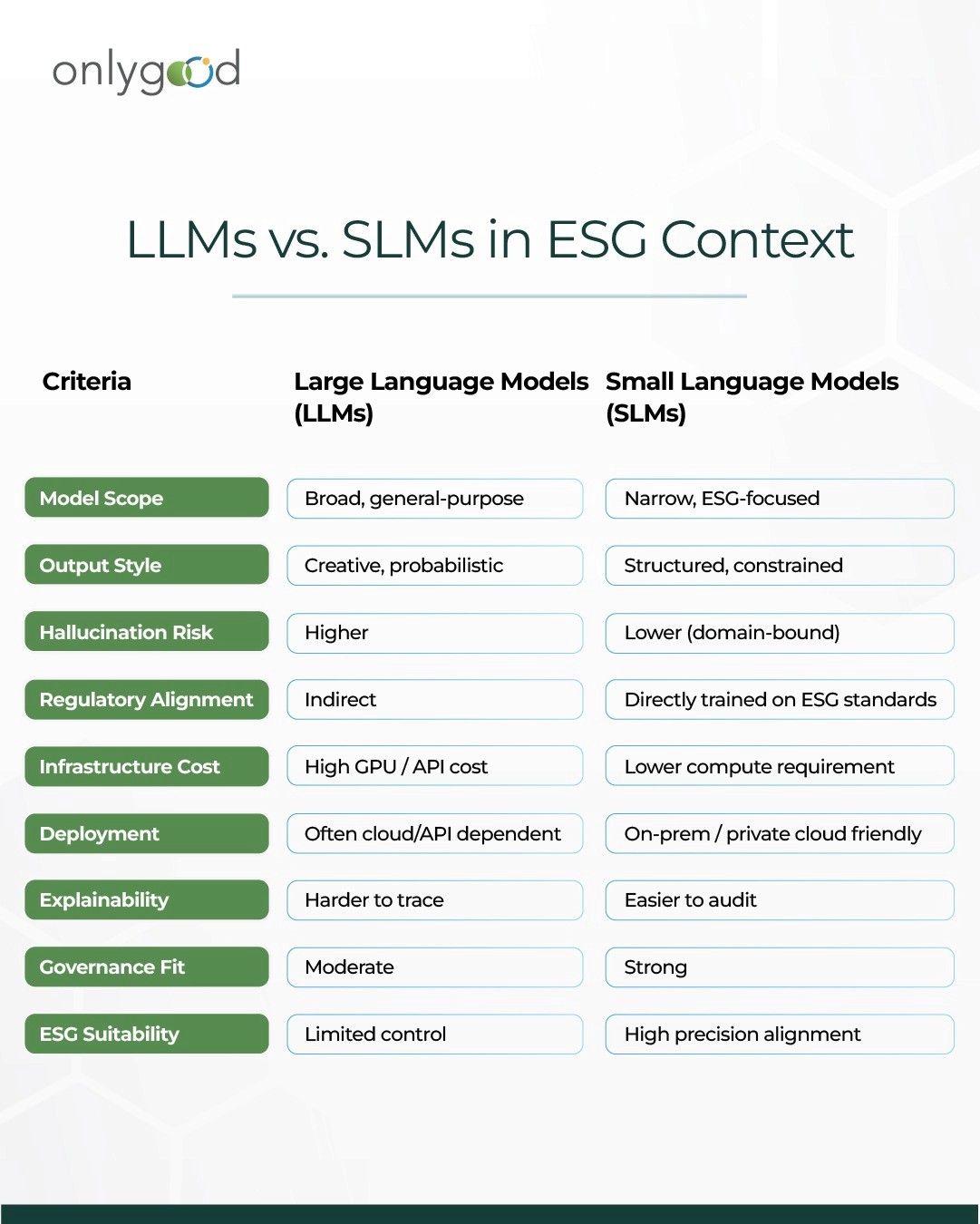
The Unique Nature of ESG Data
To understand why AI strategy in ESG must be different, we need to understand the nature of ESG data itself.
Unlike traditional enterprise data, ESG information sits at the intersection of regulation, operations, finance, and risk. It is not just descriptive, it is declarative. It makes claims and those claims can be audited.
Consider what ESG teams actually manage:
Scope 1, 2, and especially complex Scope 3 emissions calculations
Supplier-level activity data across geographies
Double materiality assessments linking financial risk and environmental impact
Cross-framework reporting (CSRD, ISSB, GRI, BRSR, CDP)
Evidence-backed disclosures subject to third-party assurance
This is not unstructured internet text. It is structured, framework-bound, traceable data.
ESG Is Framework-Constrained
Each sustainability framework has its own logic, terminology, and disclosure architecture. A single data point say, energy consumption may need to be:
Categorized differently under GRI vs. ISSB
Linked to financial materiality under CSRD
Mapped to risk disclosures in annual filings
Connected to emissions factors for GHG accounting
The intelligence required here is not generative fluency. It is controlled mapping, rule-based alignment, and contextual precision.
ESG Is Audit-Sensitive
Increasingly, ESG disclosures are subject to limited or reasonable assurance. Under regulations like CSRD, companies face legal accountability for inaccurate reporting. Investors, regulators, and rating agencies scrutinize inconsistencies.
In this context:
Hallucinations are not harmless errors.
Inconsistencies are not cosmetic flaws.
Ambiguity creates regulatory risk.
Accuracy, traceability, and explainability become non-negotiable.
ESG Is Domain-Heavy
Emissions accounting alone requires understanding:
Activity data vs. spend-based calculations
Emission factors and regional adjustments
Boundary setting and consolidation approaches
Category-specific Scope 3 methodologies
What Are Small Language Models and Why They Fit ESG Better
If Large Language Models are designed to know a little about everything, Small Language Models (SLMs) are designed to know a lot about one thing.
A Small Language Model is typically:
Trained or fine-tuned on a narrow, domain-specific dataset
Built with fewer parameters than frontier LLMs
Optimized for precision over generality
Integrated within structured workflows rather than open-ended chat
But “small” does not mean weak.
It means focused.
The Architectural Difference
Large models are optimized for:
Open-ended reasoning
Creative generation
Broad domain coverage
Conversational flexibility
Small models are optimized for:
Repetitive, high-accuracy tasks
Rule-bound decision logic
Controlled outputs
Lower compute requirements
Easier deployment in private environments
In ESG, that difference matters.
Because ESG tasks are rarely open-ended. They are constrained.
You are not asking: “Write me an imaginative story about climate change.”
You are asking:
“Map this disclosure to CSRD ESRS E1.”
“Classify this supplier under Scope 3 Category 1 or 4.”
“Flag inconsistencies between energy data and reported emissions.”
“Check alignment between narrative disclosure and numeric tables.”
These are not creative prompts. They are structured logic problems.
Why Specialization Outperforms Scale in ESG
A purpose-built SLM can be:
Fine-tuned on GHG Protocol methodologies
Constrained by ESRS disclosure logic
Embedded with predefined emission factor libraries
Guardrailed to prevent unsupported claims
Designed to output structured JSON instead of paragraphs
This dramatically reduces:
Hallucination risk
Inconsistent mapping
Overly verbose or speculative responses
Compliance exposure
The Strategic Shift
For ESG organizations, the goal is not to deploy the largest AI model available.
It is to deploy the most relevant model possible.
Small Language Models represent a shift from:
General intelligence → Domain intelligence
Conversational AI → Workflow AI
Experimentation → Governance
Hype → Reliability
And in compliance-critical environments, reliability wins.
Why Large Models Struggle in ESG Environments
Large Language Models are remarkable general-purpose systems. But their strengths are not always aligned with the realities of ESG operations.
In sustainability reporting, precision is not optional. It is regulatory.
Here are the structural reasons why deploying large, general-purpose models in ESG can introduce risk rather than resilience.
1. Hallucination Risk in Compliance Contexts
LLMs are probabilistic systems. They generate responses based on patterns in data not verified facts.
In marketing, a slightly embellished paragraph may go unnoticed. In ESG disclosures, a fabricated reference, incorrect metric, or misaligned framework mapping can lead to:
Audit qualifications
Investor mistrust
Regulatory scrutiny
Legal exposure
When disclosures are subject to third-party assurance under regulations like CSRD, explainability and source traceability are mandatory. A model that cannot clearly justify its output creates governance risk.
2. Framework Mapping Inconsistencies
Large models are trained on vast, heterogeneous data. ESG frameworks, however, are highly specific and frequently updated.
For example:
ESRS terminology differs from GRI definitions.
ISSB emphasizes investor materiality, while CSRD requires double materiality.
Scope 3 categories must follow GHG Protocol classification rules precisely.
A general-purpose model may “understand” sustainability broadly but struggle with consistent, rule-bound mapping across frameworks especially when terminology overlaps but definitions differ.
In ESG, near-correct is still incorrect.
3. Limited Explainability for Audits
Auditors increasingly expect:
Data lineage
Calculation transparency
Clear methodology documentation
Large black-box models make it difficult to explain:
Why a classification decision was made
How a materiality tag was assigned
What rule triggered a disclosure recommendation
If the AI output cannot be traced back to structured logic or predefined rules, it weakens assurance readiness.
4. Data Privacy and Governance Concerns
ESG data often includes:
Supplier-level operational information
Financial performance indicators
Energy consumption and production data
Internal risk assessments
Sending sensitive sustainability data to external, large-scale AI systems can raise:
Confidentiality concerns
Cross-border data transfer issues
Governance and cybersecurity risks
For many enterprises, especially in regulated sectors, AI deployment must align with strict internal data policies.
5. Cost vs. Use-Case Mismatch
Frontier LLMs are computationally expensive. They are designed for broad reasoning tasks that exceed the needs of most ESG workflows.
Using a massive model to classify supplier emissions or validate structured data is often like using a supercomputer to run a spreadsheet.
The cost-to-value ratio becomes misaligned.
The Core Insight
Large models are optimized for breadth and creativity.
ESG requires constraint and consistency.
When sustainability leaders adopt AI purely based on model size or brand reputation, they risk introducing volatility into systems that demand stability.
In ESG, the margin for error is narrow.
And that is precisely why the AI architecture decision matters more than the AI trend.
Where Small Language Models Win: Practical ESG Use Cases
If Large Language Models promise breadth, Small Language Models deliver control.
In ESG environments, that control translates directly into reliability, audit confidence, and operational efficiency. Below are practical areas where domain-specific SLMs create measurable advantage.
1. Framework Mapping and Cross-Standard Alignment
One of the biggest pain points for ESG teams is translating a single dataset across multiple frameworks:
CSRD (ESRS)
GRI
ISSB
BRSR
CDP
Each framework asks similar but not identical questions. Terminology overlaps. Definitions vary. Disclosure granularity differs.
A domain-trained SLM can:
Map disclosures across frameworks using predefined logic
Identify missing fields based on structured requirements
Flag inconsistencies between narrative and numeric data
Maintain version control as standards evolve
Instead of manually reconciling spreadsheets, ESG teams get rule-based mapping automation.
2. Scope 3 Emissions Classification
Scope 3 remains the most complex component of GHG accounting. It involves:
15 categories under the GHG Protocol
Supplier-level activity data
Spend-based vs. activity-based methodologies
Upstream and downstream differentiation
An ESG-focused SLM can:
Classify supplier transactions into correct Scope 3 categories
Detect anomalies in emission factors
Suggest appropriate calculation methodologies
Validate boundary definitions
Because the model is trained specifically on GHG logic, it operates within structured guardrails rather than guessing from broad sustainability language.
3. Double Materiality Screening
Under CSRD, organizations must assess both:
Impact materiality (impact on environment and society)
Financial materiality (impact on enterprise value)
This requires systematic tagging of risks, opportunities, and stakeholder concerns.
A specialized SLM can:
Categorize risks according to ESRS taxonomy
Link sustainability topics to financial exposure categories
Ensure consistency across disclosures
Generate structured documentation for audit review
Instead of free-form narrative generation, the output becomes structured and traceable.
4. ESG Data Validation and Anomaly Detection
ESG reporting often involves consolidating data from:
ERP systems
Supplier submissions
Energy bills
Production systems
Manual uploads
Errors creep in through inconsistent units, missing values, or misaligned emission factors.
An SLM embedded within the data workflow can:
Detect numerical inconsistencies
Cross-check reported emissions against activity data
Flag improbable year-over-year shifts
Validate completeness against framework requirements
This shifts AI from “content generator” to “data integrity guardian.”
5. Controlled Drafting with Guardrails
There is still a role for language generation in ESG but it must be constrained.
A small, domain-tuned model can:
Draft CDP or EcoVadis responses within predefined templates
Ensure language aligns with actual data
Prevent unsupported claims or greenwashing language
Maintain consistency across sections
The key difference is guardrails.
The model operates within:
Structured data inputs
Pre-approved language frameworks
Compliance logic
Version-controlled disclosures
That reduces reputational and regulatory risk.
The Practical Advantage
In each of these cases, the advantage of Small Language Models is not just technical, it is strategic:
Lower hallucination risk
Easier audit explainability
Better data governance
Reduced infrastructure cost
Faster deployment within enterprise systems
They are not trying to simulate general intelligence.
They are engineered to solve ESG’s specific problems.
Risk, Compliance & Trust: Why Smaller Is Safer in ESG
If there is one area where AI decisions carry real-world consequences, it is ESG.
Unlike marketing or content automation, ESG outputs are:
Submitted to regulators
Shared with investors
Used in audits
Linked to financing and penalties
An AI hallucination in a blog post is embarrassing.
An AI hallucination in a carbon disclosure or compliance filing is a liability.
In ESG, trust matters more than novelty and smaller, domain-trained models are inherently more controllable.
ESG Is a High-Stakes Environment
Frameworks such as:
Global Reporting Initiative (GRI)
Carbon Disclosure Project (CDP)
European Commission under CSRD
Securities and Exchange Commission (SEC climate rules)
require:
Precise terminology
Traceable data
Consistent methodology
Audit-ready documentation
This is not open-ended creativity.
This is structured accountability.
Large general-purpose models are optimized for linguistic fluency not regulatory precision.
Hallucination Risk Is Not Theoretical
LLMs are probabilistic systems. They generate the most statistically likely next token not necessarily the most accurate statement.
In ESG contexts, this can lead to:
Incorrect emission factors
Fabricated framework references
Misinterpretation of scope boundaries
Confident but wrong compliance statements
A small language model trained on:
Approved emission factor libraries
Specific regulatory texts
Structured ESG taxonomies
Internal methodology documents
operates inside defined guardrails.
It cannot “creatively invent” outside its domain which, in ESG, is a feature.
Data Privacy & Confidentiality
ESG platforms handle:
Supplier data
Energy consumption records
Financial exposure
Internal sustainability strategies
Many enterprises hesitate to push sensitive data through large, external foundation models.
SLMs offer:
On-prem or private-cloud deployment
Reduced data exposure
Controlled training sets
Easier audit trails
For sustainability leaders, this matters as much as accuracy.
Explainability & Governance
Board-level ESG discussions increasingly ask:
How was this emission calculated?
Which source was used?
Can we reproduce the result?
Is the methodology aligned with GRI / CSRD?
Smaller, domain-trained models:
Use narrower data sources
Operate within structured ontologies
Provide clearer traceability
That makes governance easier.
And governance is the backbone of credible sustainability.
The Strategic Insight
Large language models are impressive.
But ESG is not a creativity problem.
It is a compliance, structure, and accountability problem.
The smartest AI strategy for ESG organizations is not:
“How big can the model be?”
It is:
“How aligned is the model with the domain?”
And alignment not size is what builds long-term trust.
The Economic Case: Cost, Efficiency & ROI of Small Language Models
AI strategy in ESG cannot just be about performance. It must also make financial sense.
Sustainability teams are already working with:
Tight budgets
Expanding compliance scope
Increasing audit demands
Limited technical bandwidth
For ESG organizations, AI must reduce cost and complexity not introduce more of it.
Infrastructure Costs: Bigger Models, Bigger Bills
Large Language Models (LLMs):
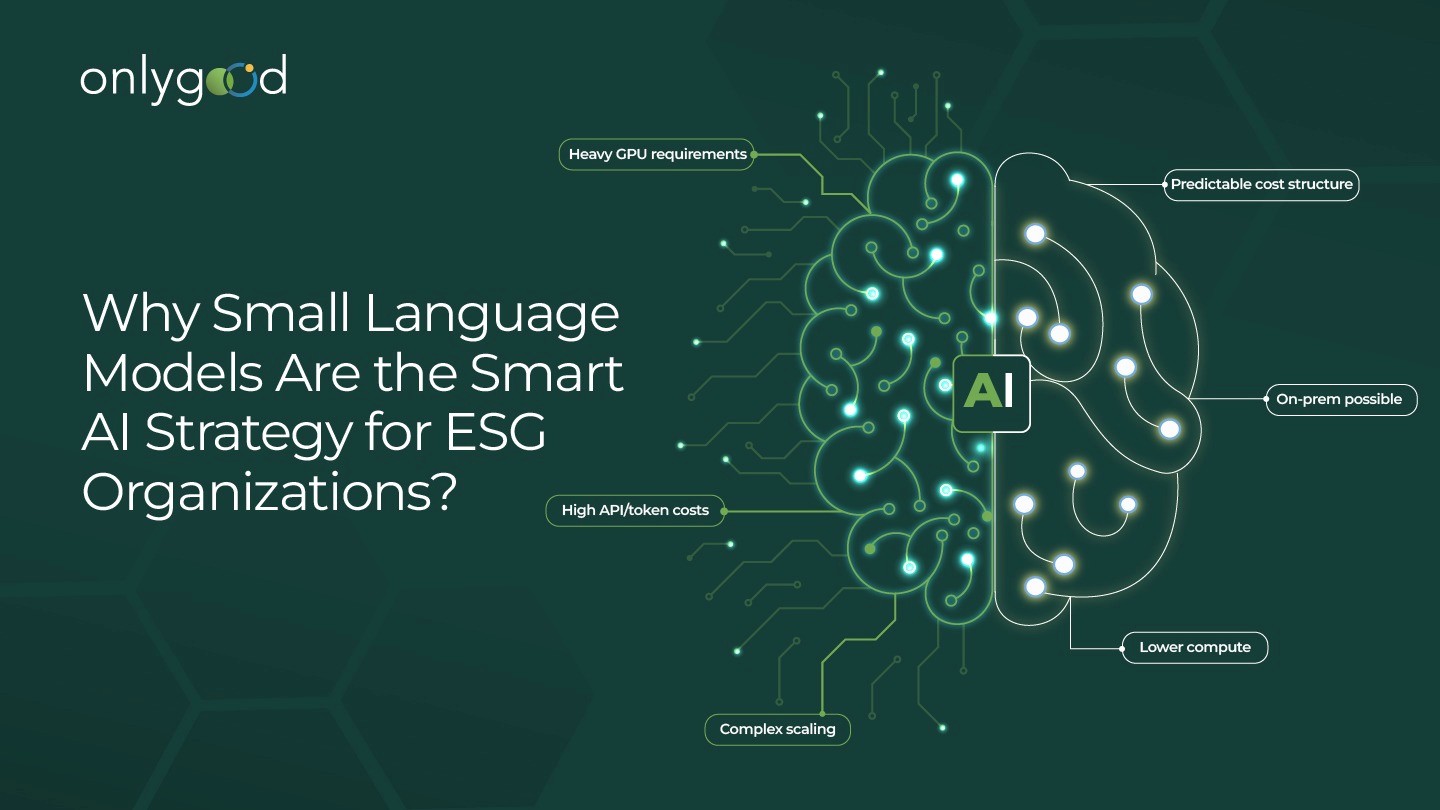
Require heavy GPU infrastructure
Consume significant inference compute
Demand constant fine-tuning
Often rely on expensive API calls
For ESG platforms processing:
Thousands of supplier submissions
Emission calculations
Reporting drafts
Compliance validations
Token costs add up quickly.
Small Language Models (SLMs):
Run on lighter infrastructure
Can be deployed on-premise
Require lower compute per query
Scale more predictably
For ESG use cases, where tasks are repetitive and structured, SLMs are far more cost-efficient.
Efficiency Gains in Structured Workflows
ESG work is not random conversation. It is structured workflow automation:
Scope 1, 2, 3 data classification
Emission factor matching
Reporting alignment with frameworks like Global Reporting Initiative
Disclosure formatting for Carbon Disclosure Project
Regulatory structuring under European Commission (CSRD)
These tasks benefit from:
Rule-based intelligence
Domain embeddings
Narrow contextual reasoning
An SLM fine-tuned on ESG-specific corpora:
Responds faster
Produces more consistent outputs
Reduces rework
Minimizes human correction cycles
That directly improves operational ROI.
Lower Risk = Lower Financial Exposure
Compliance errors have consequences:
Refiling costs
Consultant fees
Audit escalations
Potential penalties
A hallucinated data point in a sustainability report could:
Damage credibility
Trigger regulatory questions
Impact investor trust
Smaller, controlled models reduce this exposure.
And in risk-adjusted ROI calculations, reliability has economic value.
Time-to-Deployment Advantage
Training or integrating large foundation models can be complex.
SLMs:
Train faster
Fine-tune quicker
Deploy in shorter cycles
Integrate easily into ESG platforms
For organizations under pressure to meet new regulations especially under CSRD and evolving SEC climate disclosures speed matters.
Faster deployment = faster value realization.
Strategic Capital Allocation
ESG budgets should prioritize:
Data accuracy
Supplier onboarding
Measurement systems
Reduction initiatives
Not oversized AI experiments.
The smartest ESG organizations are not asking:
“How big is the model?”
They are asking:
“Does it improve reporting accuracy, reduce manual work, and protect compliance?”
And increasingly, the answer points toward small, domain-trained AI systems.
The Future of ESG AI: Domain Intelligence as Infrastructure
AI in ESG is moving past experimentation. The next phase is not about chatbots. It is about embedded intelligence.
The future of ESG AI is not bigger general models, it is domain-specific intelligence built directly into sustainability infrastructure.
From Tool to Infrastructure
In the early wave of AI adoption, organizations treated AI as an add-on:
A writing assistant
A data summarizer
A chatbot layer
But ESG platforms are evolving differently.
AI is becoming:
The engine that classifies supplier data
The system that flags compliance gaps
The layer that validates emission methodologies
The logic that aligns disclosures with frameworks
ESG Is a Structured Knowledge System
Sustainability is built on:
Emission factor databases
Regulatory texts
Sector-specific methodologies
Carbon accounting standards
Frameworks such as:
Global Reporting Initiative
Carbon Disclosure Project
European Commission (CSRD)
Securities and Exchange Commission climate disclosures
are structured systems.
The future belongs to AI that understands these structures natively.
That means:
Domain-trained embeddings
Regulatory-aware reasoning
Controlled output environments
Built-in audit traceability
Vertical AI Will Outperform Horizontal AI
Horizontal LLMs aim to know everything.
Vertical ESG AI aims to know one domain deeply.
In the coming years, we will likely see:
ESG-specific language models
Climate-risk-trained reasoning engines
Sector-specific carbon accounting systems
AI embedded inside supply-chain reporting tools
These systems will not try to answer every question.
They will answer ESG questions precisely.
Governance Will Drive Architecture
Regulators are increasing expectations around:
Transparency
Data lineage
Reproducibility
Internal controls
As ESG disclosures mature, AI systems will need:
Explainable logic
Traceable decision paths
Structured data inputs
Controlled outputs
Small, domain-constrained models are better aligned with this governance-heavy future.
The Strategic Shift
The organizations that win in ESG AI will not be the ones that adopt the biggest models.
They will be the ones that:
Embed intelligence into workflows
Align AI with regulatory architecture
Optimize for trust over novelty
Build sustainable digital infrastructure
Because ESG itself is long-term.
And the AI powering it must be designed the same way.
Final Conclusion: Why Smaller Is the Smarter Long-Term Strategy
Artificial Intelligence is transforming every enterprise function.
But ESG is not just another function.
It sits at the intersection of:
Regulation
Investor scrutiny
Operational data
Climate accountability
Long-term corporate strategy
And that changes everything.
In ESG, intelligence must be precise, explainable, and accountable, not just powerful.
The Core Misconception
The market often assumes:
Bigger model = better performance.
That assumption may hold in open-ended generative tasks.
It does not hold in ESG.
Sustainability reporting under frameworks like:
Global Reporting Initiative
Carbon Disclosure Project
European Commission (CSRD)
Securities and Exchange Commission climate rules
requires:
Structured reasoning
Controlled outputs
Audit trails
Methodological consistency
This is not a creativity challenge.
It is an accountability challenge.
Why Small Language Models Win in ESG
Small, domain-trained models:
Operate within defined ESG taxonomies
Reduce hallucination risk
Lower infrastructure and token costs
Enable on-premise deployment
Improve explainability
Align with governance requirements
Deliver faster, repeatable workflows
They are optimized for precision over possibility.
And in ESG, that trade-off is not a limitation, it is a strategic advantage.
The Strategic Perspective for Leadership
For CIOs, CSOs, and ESG Heads, the real question is not:
“Which AI model is the most impressive?”
It is:
“Which AI architecture strengthens compliance, protects credibility, and scales sustainably?”
The future of ESG technology will not be built on the biggest models available.
It will be built on:
Domain intelligence
Structured data systems
Embedded compliance logic
Responsible AI architecture
Smaller models are not a step backward.
They are a step toward maturity.
The Long-Term View
ESG is a long-term discipline.
It demands:
Consistency year over year
Transparent methodology
Reliable data flows
Strategic decision support
The AI systems powering ESG must reflect those same principles.
In the race for bigger models, it is easy to chase scale.
But in ESG, scale without structure creates risk.