Introduction: Why Most Enterprise AI Efforts Stall
Over the past few years, enterprise AI adoption has accelerated rapidly. Most organizations can point to early wins AI-driven digital marketing optimization, developer copilots, automated content generation, or productivity enhancements in technical teams. These initiatives proved an important point: the technology works.
Yet as AI experimentation has scaled, a different reality has emerged. Despite increased investment, broader access to powerful models, and growing enthusiasm across leadership teams, ROI from AI remains inconsistent at the enterprise level. Many organizations now have dozens of pilots, scattered tools, and impressive demonstrations but limited, repeatable business impact.
The root cause is often misunderstood. The challenge is no longer about model capability. Modern LLMs and SLMs are more than sufficient for a wide range of enterprise use cases. Instead, the real bottleneck lies in how AI is deployed, owned, and governed inside organizations.
Most AI efforts still operate as isolated use cases owned centrally, optimized locally, and disconnected from core workflows. As AI expands into sales, HR, finance, operations, forecasting, reporting, data ingestion, and validation, this approach no longer scales.
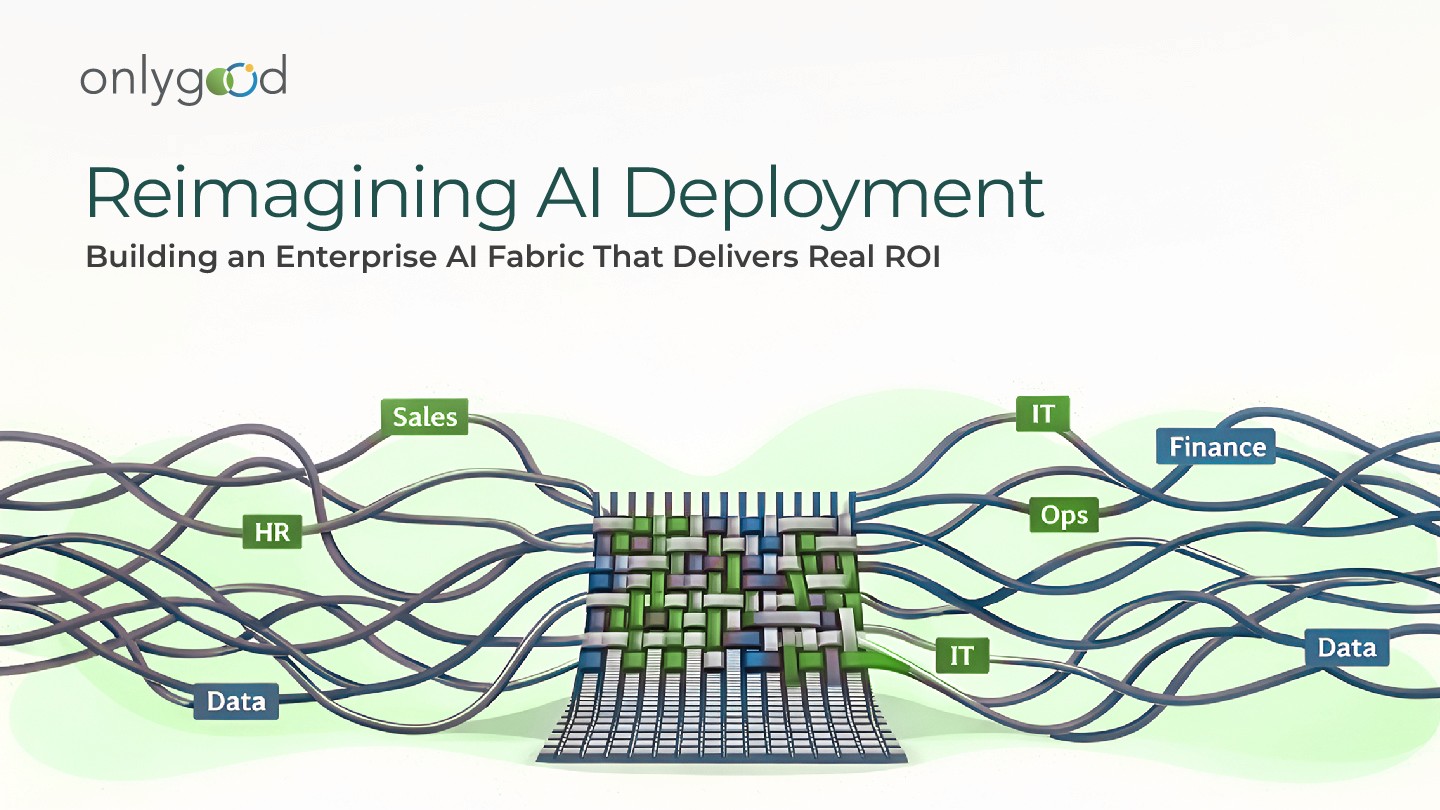
To unlock sustained value, enterprises must move beyond point solutions and rethink AI as a shared capability, an enterprise AI fabric embedded across functions, workflows, and decision-making.
This article explores why traditional AI operating models fall short and introduces a federated framework for designing, deploying, and governing AI at scale one that prioritizes clarity, orchestration, and accountability to drive real business outcomes.
The Shift: From Centralized AI Projects to an Enterprise AI Fabric
In the early stages of AI adoption, centralization made sense. Most organizations concentrate AI expertise within small teams often in data science, IT, or innovation to control risk, manage scarce skills, and experiment with emerging technologies. This model worked when AI use cases were limited in scope and largely technical in nature.
That reality has changed.
Today, AI is no longer confined to a handful of centralized projects. It is increasingly embedded across core business functions supporting sales recommendations, HR decision-making, financial forecasting, report generation and validation, supplier data ingestion, and operational analytics. These are not experimental edge cases; they are everyday workflows that directly impact revenue, cost, risk, and customer experience.
As AI expands into these domains, the limitations of a centralized model become clear. Central teams struggle to understand the nuances of every function, become bottlenecks for deployment, and are forced to prioritize governance over velocity. At the same time, functional teams feel disconnected from AI initiatives that are meant to serve them, leading to low adoption and unclear accountability for outcomes.
What emerges instead is the need for a different approach, one that treats AI not as a collection of standalone projects, but as an enterprise-wide fabric.
An enterprise AI fabric enables AI capabilities to be shared, reused, and embedded across functions while remaining adaptable to the specific workflows and objectives of each team. It shifts AI from something “delivered” by a central group to something co-owned by the business, supported by a common architecture and governed through shared standards.
This shift is not just architectural, it is organizational. It requires rethinking who defines use cases, who designs workflows, who selects tools, and who is ultimately responsible for generating value. And it sets the stage for a more fundamental insight: while AI can optimize and automate, it cannot define why it should be applied in the first place.
A Core Insight: AI Cannot Define the “Why”
As AI capabilities advance, it is tempting to assume that better models will naturally lead to better business outcomes. In practice, the opposite is often true. As tools become more powerful and accessible, organizations risk deploying AI everywhere without a clear understanding of why it belongs in a given workflow.
This highlights a critical but often overlooked reality: AI cannot define business intent.
Large language models, small language models, and intelligent agents excel at pattern recognition, prediction, optimization, and automation. They can recommend actions, generate outputs, and accelerate decisions. What they cannot do is determine which problems are worth solving, which trade-offs matter, or what success should look like in a specific business context.
That responsibility belongs to the functional teams closest to the work.
Sales leaders understand where recommendations truly influence conversion. HR teams know which decisions require judgment versus automation. Finance and operations teams understand where forecasting accuracy or reporting validation creates real leverage. These insights cannot be inferred from data alone they are rooted in domain expertise, incentives, and lived experience.
When AI initiatives are driven primarily by tools or central teams, this “why” often gets lost. Use cases are defined in abstract terms, workflows are loosely connected to real processes, and success metrics remain vague. The result is AI that looks impressive in isolation but struggles to deliver sustained value.
Recognizing that AI cannot define the “why” fundamentally changes how enterprises should deploy it. Instead of pushing AI into the business, organizations must enable the business to pull AI in on its own terms, aligned to its own objectives.
This insight becomes the foundation for a federated approach to AI, where functional teams are empowered to identify meaningful use cases, design effective workflows, and take ownership of outcomes while operating within a shared architectural and governance framework.
Introducing the Federated AI Fabric Framework
If AI cannot define the “why,” then any scalable AI operating model must begin with the business not the technology. This is where many enterprise AI strategies break down: they attempt to solve organizational challenges with architectural solutions alone.
To address this gap, we introduce the Federated AI Fabric Framework, a practical model for designing, deploying, and governing AI at scale while maintaining both velocity and control.
At its core, the framework is built on a simple premise: AI should be owned by the business, enabled by shared architecture, and governed through federation rather than centralization.
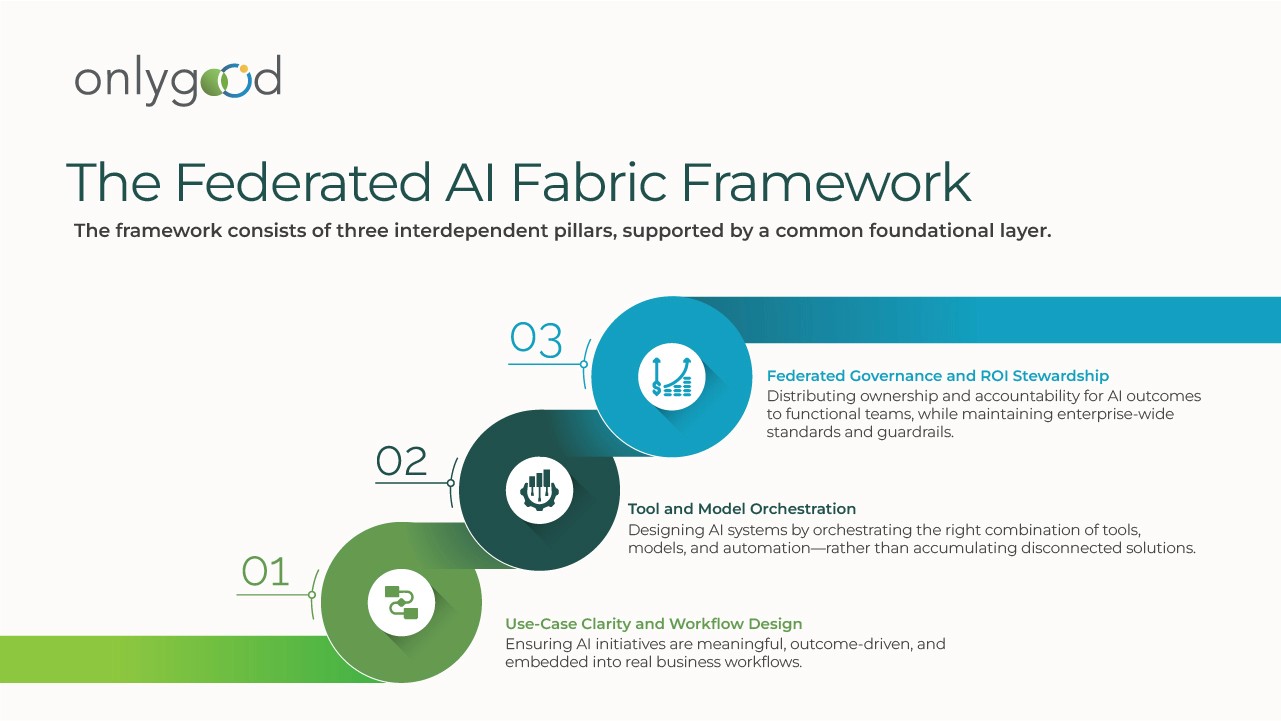
The framework consists of three interdependent pillars, supported by a common foundational layer:
Use-Case Clarity and Workflow Design: Ensuring AI initiatives are meaningful, outcome-driven, and embedded into real business workflows.
Tool and Model Orchestration: Designing AI systems by orchestrating the right combination of tools, models, and automation—rather than accumulating disconnected solutions.
Federated Governance and ROI Stewardship: Distributing ownership and accountability for AI outcomes to functional teams, while maintaining enterprise-wide standards and guardrails.
These pillars sit on top of a shared AI architecture and data foundation, which provides consistency, security, and reuse across the enterprise.
What differentiates this framework from traditional AI maturity models is its emphasis on ownership and accountability. Functional teams identify use cases, design workflows, and own ROI. Central AI and platform teams define standards, frameworks, and guardrails. Governance enables progress rather than constraining it.
Together, these elements create an AI fabric that is adaptable to the needs of individual teams while remaining coherent at the enterprise level supporting not just faster experimentation, but continuous evaluation, improvement, and retirement of AI initiatives over time.
Pillar 1: Use-Case Clarity and Workflow Design
Every successful AI initiative begins with clarity about the problem being solved, the workflow it supports, and the outcome it is expected to deliver. Without this foundation, even the most advanced AI models struggle to create meaningful impact.
In a federated AI fabric, use-case identification does not start with technology. It starts with functional teams asking a simple but powerful question: Where does better decision-making, automation, or insight materially change outcomes in our workflow?
Too often, AI use cases are defined in broad terms “improve productivity,” “automate reporting,” or “enhance insights.” While well-intentioned, these goals are rarely specific enough to guide effective design or measure success. High-impact AI initiatives, by contrast, are tightly coupled to real, observable workflows: how sales teams prioritize leads, how HR screens candidates, how finance validates reports, or how operations forecast demand.
Equally important is designing for effectiveness before efficiency. Automating a broken or poorly understood process only accelerates inefficiency. Functional teams must first understand what “good” looks like in their context, what decisions matter, what constraints exist, and where human judgment is essential before introducing AI to scale or streamline those decisions.
Experimentation plays a critical role at this stage, but it must be intentional. Successful teams define success metrics upfront, establish feedback loops, and set explicit criteria for when a use case should be modified or retired. This discipline prevents AI portfolios from becoming cluttered with low-value initiatives.
Ownership is the defining factor. Functional teams own the full lifecycle of their AI use cases from identification and design to evaluation and deprecation ensuring alignment with evolving business priorities.
Pillar 2: Tool and Model Orchestration
Once use cases are clearly defined and embedded within real workflows, the next challenge is execution: assembling the right combination of tools and models to deliver results efficiently and sustainably.
In many organizations, this is where complexity explodes. The rapid proliferation of AI tools, platforms, and models creates the illusion of progress while quietly introducing fragmentation, redundancy, and rising costs.
The Federated AI Fabric Framework takes a different stance: the value of enterprise AI lies not in individual tools, but in how they are orchestrated across workflows.
Different tasks demand different capabilities. Simple, repetitive actions may be best handled by smaller, task-specific models. More complex reasoning or generative tasks may require larger language models. Often, real value emerges only when models are combined with retrieval systems, validation layers, automation tools, and human-in-the-loop checkpoints.
Effective orchestration means designing AI systems that are:
Workflow-centric, not model-centric
Modular and replaceable
Composable across use cases
Cost-aware and value-aligned
Rather than standardizing on a single model or vendor, central AI architecture teams define approved patterns, interfaces, and guardrails, while functional teams determine which combinations are most effective for their needs.
This approach reduces lock-in and increases adaptability critical in a landscape where AI capabilities evolve faster than enterprise planning cycles.
Pillar 3: Federated Governance and ROI Stewardship
As AI adoption expands, governance becomes unavoidable. The question is not whether AI should be governed, but how.
The Federated AI Fabric Framework adopts a federated model freedom within guardrails.
Functional teams act as stewards of value. They are responsible for defining success metrics, monitoring performance, deciding when to modify or retire use cases, and demonstrating measurable ROI.
Central governance teams, meanwhile, establish enterprise-wide standards for security, privacy, model risk, and architectural consistency. Their role is to enable progress, not act as gatekeepers.
This model creates transparency. Costs, performance, and impact are visible at the level of individual use cases, making it easier to scale what works and sunset what doesn’t. Innovation is measured not by the number of pilots launched, but by the value sustained over time.
The Foundation: AI Architecture, Data, and Standards
The Federation only works on top of a strong foundation. Without it, distributed ownership leads to fragmentation.
Central AI, platform, and data teams are responsible for establishing shared standards for data access, security, model lifecycle management, observability, and cost transparency. These standards remove friction for teams, enabling speed without compromising safety.
Model standardization without rigidity is key. Approved model families, evaluation criteria, and reference architectures provide consistency while preserving flexibility. Reusable components compound value over time, making each new AI initiative faster and less costly to launch.
How the Federated AI Fabric Model Drives Sustainable ROI
This framework improves ROI by ensuring AI initiatives are business-led, orchestrated efficiently, governed with accountability, and supported by a reusable foundation. It enables continuous adaptation as priorities shift and capabilities evolve.
The result is a durable enterprise capability, not a collection of disconnected experiments.
Leaders should start by assessing current AI initiatives through the lens of ownership and outcomes. Shift from a tool-first mindset to a workflow-first approach. Pilot federation in a few functions, invest in the foundation, and focus central teams on enablement rather than control.
Ultimately, AI success is less about technology and more about operating models.
Enterprises that embrace a federated AI fabric will be best positioned to turn experimentation into lasting competitive advantage.