Introduction: A Defining Moment for EU Automotive
The European automotive industry has entered a decisive phase in its sustainability journey. What was once driven by incremental improvements, voluntary disclosures, and pilot initiatives is now being reshaped by binding regulation, standardized measurement, and digital accountability. ESG is no longer evolving at the margins, it is being hardwired into how automotive businesses operate, report, and compete.
The EU Green Deal marks a fundamental structural shift. Sustainability is no longer aspirational or interpretive; it is mandated, measurable, and increasingly digital. Through frameworks such as CSRD and ESRS, environmental and social performance is being elevated to the same level of rigor as financial reporting. This transition signals a clear message from regulators and markets alike: ESG outcomes must be comparable, auditable, and decision-ready.
As a result, ESG is no longer a peripheral compliance function. It is now directly influencing cost structures, access to customers, supply chain resilience, and long-term competitiveness. Decisions around sourcing, logistics, product design, and supplier engagement are being scrutinized not only for efficiency, but for their sustainability impact across the value chain.
At the center of this transformation lies Scope 3 emissions. Representing the majority of automotive emissions and spanning complex, multi-tier supply chains and product use, Scope 3 has emerged as the industry’s primary challenge and its greatest strategic opportunity. No longer confined to disclosure, Scope 3 is fast becoming the battleground where regulatory readiness, operational intelligence, and competitive advantage converge.
This is why it matters now. The companies that treat ESG and especially Scope 3 as a strategic capability rather than a reporting obligation will define leadership in the next decade of European automotive.
The Inflection Point: How Regulation Is Rewriting ESG Expectations
The most profound change facing the European automotive sector is not technological, it is regulatory. ESG is no longer shaped by corporate ambition alone; it is being systematically standardized, enforced, and made comparable across industries and geographies. This shift marks a true inflection point in how sustainability performance is defined, measured, and evaluated.
Regulatory Pacemaker: Mandatory Standardization and Transparency
At the core of this transformation is the Corporate Sustainability Reporting Directive (CSRD), which from 2025 significantly expands the scope, depth, and rigor of sustainability reporting across the EU. Under CSRD, companies must report in line with the European Sustainability Reporting Standards (ESRS), creating a harmonized framework that enables regulators, investors, and stakeholders to assess sustainability performance consistently and at scale.
This represents a decisive shift from a fragmented landscape of voluntary disclosures to a system of mandatory, standardized, and comparable reporting. ESG data is no longer contextual or selectively presented; it is structured, benchmarkable, and subject to scrutiny across value chains. For the automotive industry, characterized by complex supplier networks and global operations this standardization removes ambiguity while simultaneously raising the bar for data quality and completeness.
A central pillar of CSRD is the principle of double materiality. Companies are now required to assess and disclose not only how sustainability risks and opportunities affect their financial performance, but also how their activities impact the environment and society. This dual lens forces a fundamental mindset shift: sustainability is no longer evaluated solely through financial exposure, but through real-world consequences across ecosystems, communities, and value chains.
Equally transformative is the role of digital reporting. CSRD mandates the use of machine-readable formats, notably XBRL, embedding ESG data into digital financial infrastructure. This is not a technical footnote, it is the enforcement mechanism. Digital tagging enables automated validation, comparability, and analysis, significantly reducing the tolerance for inconsistent, incomplete, or unverifiable disclosures.
Together, these changes redefine ESG expectations for the EU automotive sector. Sustainability data is now treated with the same rigor as financial data, governed by standards, verified through digital systems, and increasingly used to inform capital allocation, procurement decisions, and regulatory oversight. The era of narrative-led ESG reporting is over; what follows is a data-driven, auditable, and accountability-focused reality.
Decarbonization Reality Check: Why Scope 3 Is the Systemic Failure Point
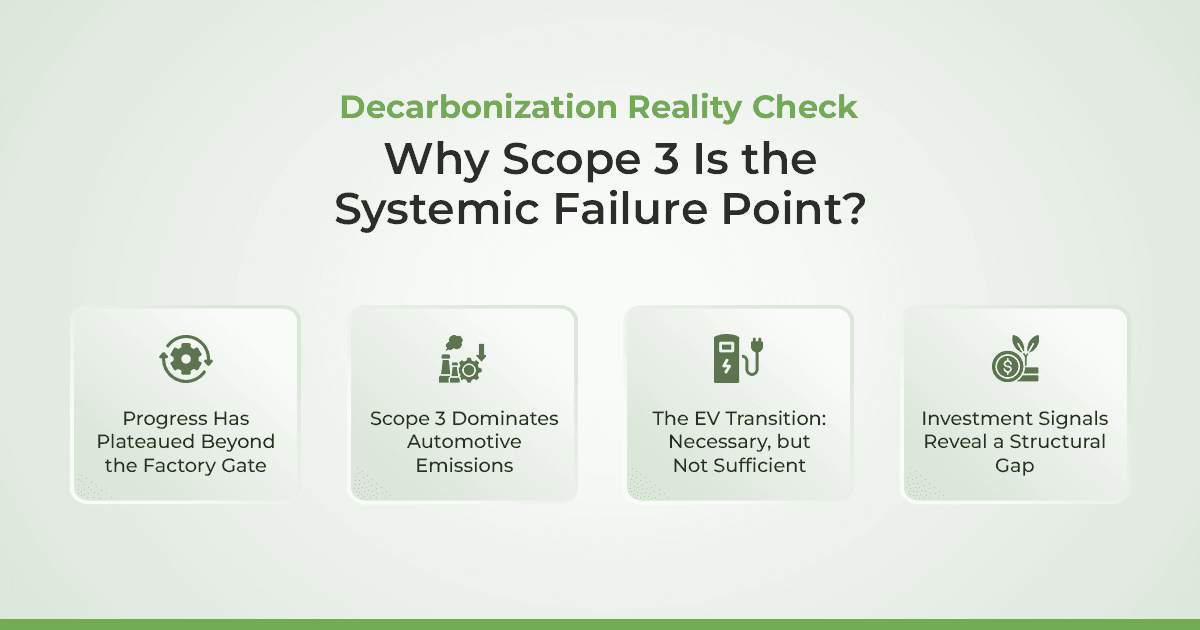
Despite heightened ambition and increasing regulatory pressure, the European automotive sector remains off track on its climate objectives. While progress has been made in specific areas, overall decarbonization is not advancing at the pace required to align with the EU’s 1.5°C pathway. The gap between targets and outcomes reveals a critical truth: the industry’s decarbonization challenge is no longer operational: it is systemic, and it is concentrated in Scope 3.
Progress Has Plateaued Beyond the Factory Gate
Over the past decade, automotive manufacturers have achieved measurable success in reducing emissions from their own operations. Scope 1 and Scope 2 emissions have increasingly been decoupled from production volumes through energy efficiency measures, process optimization, and the transition to renewable electricity. These gains, however, represent the “low-hanging fruit” of decarbonization.
Beyond internal operations, progress slows dramatically. Between 2021 and 2023, total value-chain emissions across Scopes 1, 2, and 3 declined by only around 3%. This reduction falls well short of the approximately 4.2% annual decrease required to remain aligned with the 1.5°C climate goal. In practical terms, this means that even as factories become cleaner, the overall emissions footprint of the sector remains largely unchanged.
Scope 3 Dominates Automotive Emissions
The reason for this stagnation is clear: Scope 3 emissions account for the vast majority of the automotive sector’s climate impact estimated at close to 80%. These emissions span upstream raw material extraction, component manufacturing, logistics, and, most significantly, the vehicle use phase over its lifetime.
This concentration of emissions outside direct operational control makes Scope 3 both difficult and unavoidable. Improvements in manufacturing efficiency alone cannot deliver meaningful sector-wide reductions if emissions embedded in products, suppliers, and downstream use remain unaddressed. As long as Scope 3 emissions remain opaque or unmanaged, overall decarbonization efforts will continue to plateau.
The EV Transition: Necessary, but Not Sufficient
Electrification has been positioned as the primary pathway to automotive decarbonization, yet its current trajectory underscores the limits of relying on a single strategy. To meet the effective 2035 phase-out of internal combustion engine vehicle sales, battery electric vehicle (BEV) market share would need to increase by an average of seven percentage points annually, more than double the current growth rate.
Market hesitation, infrastructure constraints, and affordability concerns have already led several OEMs to recalibrate or delay electrification targets. Even where EV adoption accelerates, emissions reductions remain highly dependent on external factors such as grid decarbonization, battery supply chains, and material sourcing. As a result, electrification alone cannot guarantee timely or sufficient Scope 3 reductions.
Investment Signals Reveal a Structural Gap
Quantitative analysis further highlights the imbalance in decarbonization effectiveness. Investments in tangible assets such as manufacturing infrastructure and process upgrades show a clear and positive impact on reducing direct (Scope 1) emissions. However, the effect of these investments on indirect Scope 2 and systemic Scope 3 emissions is far less conclusive.
This suggests that Scope 3 outcomes are influenced less by isolated capital expenditure and more by coordinated action across suppliers, logistics networks, energy systems, and product design. In other words, Scope 3 emissions cannot be “engineered away” within organizational boundaries; they must be actively managed across the value chain.
Scope 3 as the Decarbonization Bottleneck
Taken together, these dynamics position Scope 3 as the primary bottleneck to meaningful climate progress in the EU automotive sector. It is where ambition slows, targets slip, and accountability becomes diffuse. Yet it is also where the greatest potential for impact lies.
The challenge facing automotive leaders is no longer whether Scope 3 matters, it is how quickly they can move from fragmented visibility and reactive reporting to structured, data-driven control. The next phase of ESG leadership will be defined by who can translate Scope 3 complexity into coordinated decarbonization at scale.
Scope 3 Reframed: From Compliance Burden to Strategic Advantage
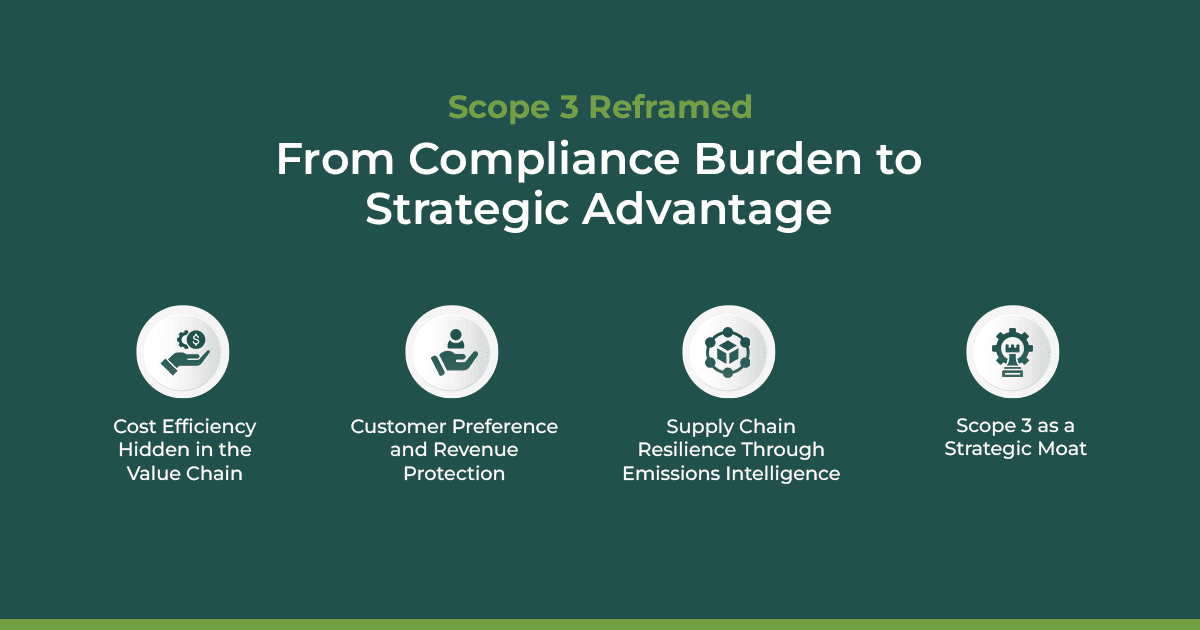
For many automotive companies, Scope 3 has become synonymous with complexity, fragmented supplier data, limited control, and escalating reporting demands. Yet this perception misses a critical shift underway. As regulation, customer expectations, and digital capability converge, Scope 3 is evolving from a compliance requirement into a powerful source of strategic advantage.
What differentiates leaders from laggards is not the scale of their Scope 3 footprint, but the depth of their visibility and their ability to act on it.
Cost Efficiency Hidden in the Value Chain
Scope 3 emissions data exposes inefficiencies that are often invisible in traditional cost analysis. Emissions hotspots frequently align with operational waste inefficient logistics routes, material overuse, energy-intensive processes, and redundant workflows across the supply chain.
By mapping emissions across suppliers, transport modes, and materials, companies can identify opportunities for route optimization, material substitution, waste reduction, and process streamlining. These interventions not only reduce emissions but also deliver tangible cost savings. In this sense, Scope 3 management becomes a lens for operational efficiency, not an added expense.
Customer Preference and Revenue Protection
OEMs, fleet buyers, and global customers are increasingly embedding Scope 3 considerations into procurement decisions. Clean, credible value-chain emissions data is no longer a differentiator; it is a prerequisite to compete.
Suppliers that can provide audit-ready Scope 3 data, demonstrate lower embedded emissions, and articulate credible reduction pathways are better positioned to win tenders and maintain preferred-supplier status. Conversely, weak Scope 3 visibility introduces commercial risk, as customers seek partners who support their own climate commitments and reporting obligations.
In this context, Scope 3 performance directly influences revenue access and customer trust.
Supply Chain Resilience Through Emissions Intelligence
Beyond compliance and customer expectations, Scope 3 visibility enhances supply chain resilience. Emissions data provides early insight into supplier risk highlighting dependencies on carbon-intensive materials, geographies exposed to regulatory or environmental disruption, and partners vulnerable to transition risk.
With structured Scope 3 data, procurement and sustainability teams can proactively identify high-risk suppliers, diversify sourcing strategies, and engage partners on improvement plans before disruptions occur. Emissions intelligence thus becomes a risk-management tool, strengthening continuity and long-term supply security.
Supply Chain Resilience Through Emissions Intelligence
Scope 3 insights also influence how products are designed, not just how they are reported. Understanding emissions at the product and component level enables informed decisions on low-carbon materials, circular design principles, optimized packaging, and extended product lifecycles.
These choices unlock new innovation pathways supporting regulatory readiness, enhancing brand credibility, and opening access to emerging low-carbon markets. In many cases, reduced product-level emissions translate directly into increased customer trust and long-term brand value.
Scope 3 as a Strategic Moat
When managed systematically, Scope 3 becomes more than a reporting category it becomes a strategic moat. Companies that build structured, scalable approaches to value-chain emissions gain advantages that are difficult to replicate: lower costs, stronger customer alignment, reduced risk, and accelerated innovation.
As ESG expectations continue to rise, the question is no longer whether Scope 3 will shape competitive outcomes, but which organizations will move early enough to turn complexity into leadership.
ESG’s Next Frontier: Lifecycle Accountability Becomes Mandatory
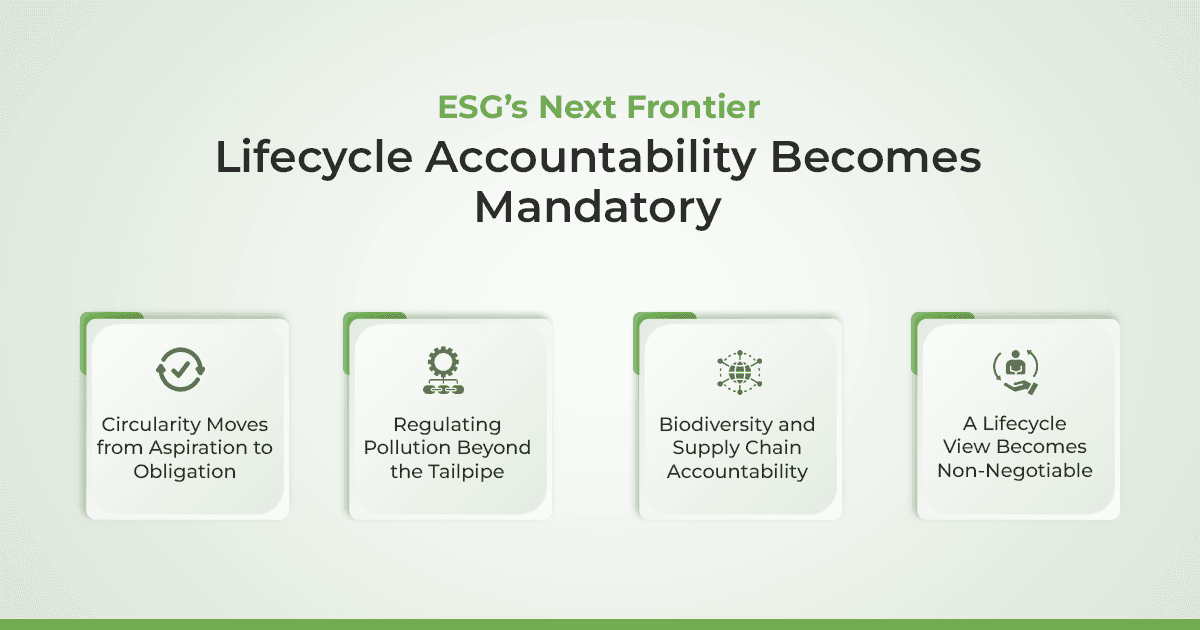
As decarbonization challenges intensify, regulation is simultaneously broadening the definition of sustainability in the automotive sector. ESG is no longer centered solely on tailpipe emissions or energy use; it now spans the full product lifecycle and the wider environmental and social ecosystems in which automotive value chains operate. This expansion fundamentally reshapes risk, responsibility, and strategic planning for the industry.
Circularity Moves from Aspiration to Obligation
One of the clearest signals of this shift is the EU Battery Regulation, which establishes binding requirements across the entire battery lifecycle. The regulation introduces mandatory recycling efficiencies, performance standards, and minimum quotas for secondary raw material content including critical materials such as cobalt, lithium, and nickel beginning in 2031 and tightening further by 2036.
Complementing these requirements is the introduction of the Battery Passport, mandated from 2027. The passport will provide standardized, digital transparency on battery composition, carbon footprint, sourcing, and end-of-life handling. Together, these measures force OEMs and suppliers to design for circularity from the outset, integrating recyclability, traceability, and secondary material sourcing into product development and procurement strategies.
Circularity is no longer a sustainability ambition; it is becoming a regulated operating condition.
Regulating Pollution Beyond the Tailpipe
The scope of environmental accountability is also expanding beyond exhaust emissions. The upcoming Euro 7 emissions standard, expected to take effect from November 2026, represents a significant regulatory evolution by addressing non-exhaust emissions for the first time.
Euro 7 introduces limits on brake particle emissions and tire abrasion now recognized as the largest source of microplastic pollution in the European Union. These requirements apply regardless of powertrain type, meaning that electric vehicles will also be subject to stricter environmental controls. This shift underscores a critical reality: electrification alone does not eliminate environmental impact, and sustainability performance must be evaluated holistically across vehicle design, materials, and usage.
Biodiversity and Supply Chain Accountability
Beyond climate and pollution, new regulations are extending ESG accountability into biodiversity protection and human rights across supply chains. Instruments such as the Corporate Sustainability Due Diligence Directive (CSDDD) and the EU Deforestation Regulation require companies to identify, prevent, and mitigate environmental and social risks throughout their value chains.
For the automotive sector, this has particular relevance in the sourcing of raw materials, including those used in batteries and electronics. Companies are now expected to demonstrate due diligence related to land use, ecosystem degradation, and deforestation risks linked to upstream suppliers. Failure to do so introduces not only compliance risk, but reputational and operational exposure.
A Lifecycle View Becomes Non-Negotiable
Taken together, these regulatory developments signal a decisive shift toward lifecycle-based accountability. ESG expectations now encompass material extraction, manufacturing, product use, and end-of-life outcomes requiring coordinated data, supplier engagement, and cross-functional governance.
For automotive leaders, this expanded scope demands a transition from siloed sustainability initiatives to integrated management systems that can track, verify, and act on ESG impacts across the entire ecosystem. The ability to connect carbon, circularity, pollution, and biodiversity considerations within a single strategic framework will increasingly define both compliance readiness and competitive leadership.
What This Means for Automotive Leaders
The regulatory and market shifts reshaping the EU automotive sector leave little room for incremental responses. ESG is no longer a reporting exercise that can be managed in isolation; it is becoming a core management discipline that directly influences competitiveness, resilience, and long-term value creation. For automotive leaders, the challenge is not simply to comply, but to adapt operating models to this new reality.
ESG Must Move into Core Business Management
The elevation of ESG to mandatory, standardized, and digital reporting means sustainability data must be treated with the same discipline as financial data. This requires embedding ESG ownership across functions procurement, operations, product design, finance, and risk—rather than confining it to sustainability teams alone.
Leadership attention is increasingly required to align ESG priorities with business strategy, ensuring that decisions around sourcing, investment, and innovation are informed by reliable, auditable sustainability data.
Scope 3 Demands Structured, Scalable Control
Given its scale and complexity, Scope 3 cannot be managed through manual processes or fragmented supplier engagement. Leaders must move toward structured systems that enable consistent data collection, supplier collaboration, and emissions visibility across the value chain.
This shift is not purely technical. It requires governance models that define accountability, incentives that encourage supplier participation, and decision frameworks that translate emissions data into concrete action. Companies that delay this transition risk falling into a cycle of reactive reporting and escalating compliance pressure.
Digital Infrastructure Becomes a Strategic Enabler
Digitalization is no longer optional in ESG management. Machine-readable reporting, audit trails, and real-time dashboards are rapidly becoming baseline expectations under regulations such as CSRD. Without the right digital infrastructure, organizations face rising compliance costs, data quality issues, and limited decision-making capability.
Conversely, companies that invest early in ESG intelligence platforms gain operational efficiency, improved data confidence, and the ability to respond quickly to regulatory and customer demands. Digital ESG systems increasingly function as strategic enablers rather than back-office tools.
Leadership Advantage Lies in Integration, Not Fragmentation
The expanding scope of ESG covering carbon, circularity, pollution, and biodiversity requires integrated management rather than disconnected initiatives. Leaders must ensure that ESG data, supplier engagement, and risk assessment are coordinated across the organization and aligned with long-term business objectives.
Those who succeed will not only reduce compliance risk, but also unlock cost efficiencies, strengthen supply chain resilience, and position themselves as preferred partners in an increasingly sustainability-driven market.
Who Will Lead the Next Decade
The transformation underway in the EU automotive sector is neither temporary nor incremental. It reflects a structural redefinition of how sustainability, risk, and competitiveness intersect. Regulation has established the baseline. Market expectations are accelerating the pace. What remains is a question of leadership.
Scope 3 sits at the center of this transformation. It is where emissions are concentrated, where value chains are most complex, and where accountability is hardest to enforce. Yet it is also where the greatest opportunities exist to reduce costs, strengthen customer relationships, build resilient supply chains, and drive product innovation.
The companies that will lead the next decade are not those that treat ESG as a compliance obligation, nor those that wait for perfect data or regulatory certainty. Leadership will belong to organizations that act early, invest in structured and scalable approaches, and integrate sustainability into core business decision-making.
As ESG expectations expand beyond carbon to encompass circularity, pollution, and ecosystem protection, competitive advantage will increasingly depend on the ability to manage complexity with clarity. Those who succeed will turn regulation into a catalyst, Scope 3 into a strategic asset, and sustainability into a durable source of trust and long-term value.