Introduction
For most companies today, Scope 3 emissions have become the single biggest blind spot in their sustainability journey. They sit outside direct operations, buried across suppliers, logistics partners, distributors, and even product end-use, making them incredibly difficult to measure, report, or manage. In many industries, Scope 3 accounts for 70–95% of total emissions, yet remains the least understood and least controlled.
The challenge is clear: you cannot reduce what you cannot see and most organisations still lack visibility beyond their immediate operations. This is why major global frameworks and regulators from CSRD and CBAM in the EU to customer portals used by large OEMs are intensifying their focus on Scope 3. What once felt optional has become an urgent priority.
As PwC notes in their analysis of the global Scope 3 landscape, the real difficulty isn’t just the volume of emissions, it’s the complexity, the data gaps, and the dependency on suppliers that make Scope 3 uniquely challenging.
Organisations that understand and actively manage their value-chain emissions are unlocking benefits that go far beyond reporting:
stronger customer trust,
reduced operational risk,
better supplier performance,
and more resilient business models.
In other words, Scope 3 has moved from a “problem to solve” to a “strategic l
ever to pull.”
This blog explores how companies can transform Scope 3 from a regulatory burden into a business advantage and why those who do so early will lead their industries in the decade ahead.
The Business Case for Tackling Scope 3
For many companies, Scope 3 used to be the “final frontier” of sustainability, too complex, too external, and too difficult to control. But the landscape has shifted dramatically. Today, organisations that proactively address Scope 3 are finding themselves in a stronger competitive position than those who simply try to keep up.
2.1 Compliance Isn’t Enough: Scope 3 Defines Market Access
Regulations around the world including CSRD, CBAM, SEC climate disclosures, and India’s BRSR have made value-chain transparency a baseline expectation. Companies that cannot provide reliable Scope 3 data now risk:
Losing access to key global markets
Facing higher carbon border taxes
Failing customer audits from OEMs
Being dropped from supplier lists
This is no longer theoretical. Large buyers in automotive, FMCG, pharma, and retail already require suppliers to submit category-wise Scope 3 data into digital customer portals.
As PwC notes in their deep dive on the Scope 3 challenge, the real difficulty stems from data inconsistency, supplier dependency, and lack of integrated systems all of which slow down reporting and increase compliance risk.
Companies that sort out this complexity early gain a significant edge.
2.2 A Differentiator for Customers, Investors, and Talent
Across industries, buyers are prioritising suppliers that can demonstrate credible, transparent emissions reporting and reduction plans. Investors are making similar demands, treating climate readiness as a signal of long-term resilience.
Organisations that lead on Scope 3 enjoy:
Stronger customer trust
Higher chances of winning RFPs
Better ESG ratings
Improved brand reputation
A magnet effect for climate-aligned talent
Managing Scope 3 communicates maturity and future-readiness critical traits in markets increasingly shaped by climate expectations.
2.3 Operational Efficiency and Cost Reduction Opportunities
Contrary to what many believe, Scope 3 isn’t only about carbon it’s also about cost, efficiency, and supply-chain performance.
When organisations map and analyse their value-chain emissions, they uncover inefficiencies such as:
High-emission, high-cost suppliers
Poor logistics routing
Energy-intensive materials
Redundant processes
Low-yield operations
These insights translate into real business savings.
The ACT Group highlights that reducing supply-chain emissions directly creates lower costs, reduced risk exposure, and improved supplier performance, reinforcing Scope 3 as a financial advantage.
2.4 Future-Proofing Through Innovation
When companies begin actively measuring Scope 3, it naturally pushes them toward innovation:
Low-carbon materials
Circular product design
Smarter logistics
Demand forecasting connected to carbon intensity
Supplier innovation partnerships
Scope 3 becomes a catalyst for better products, smarter processes, and more resilient supply chains.
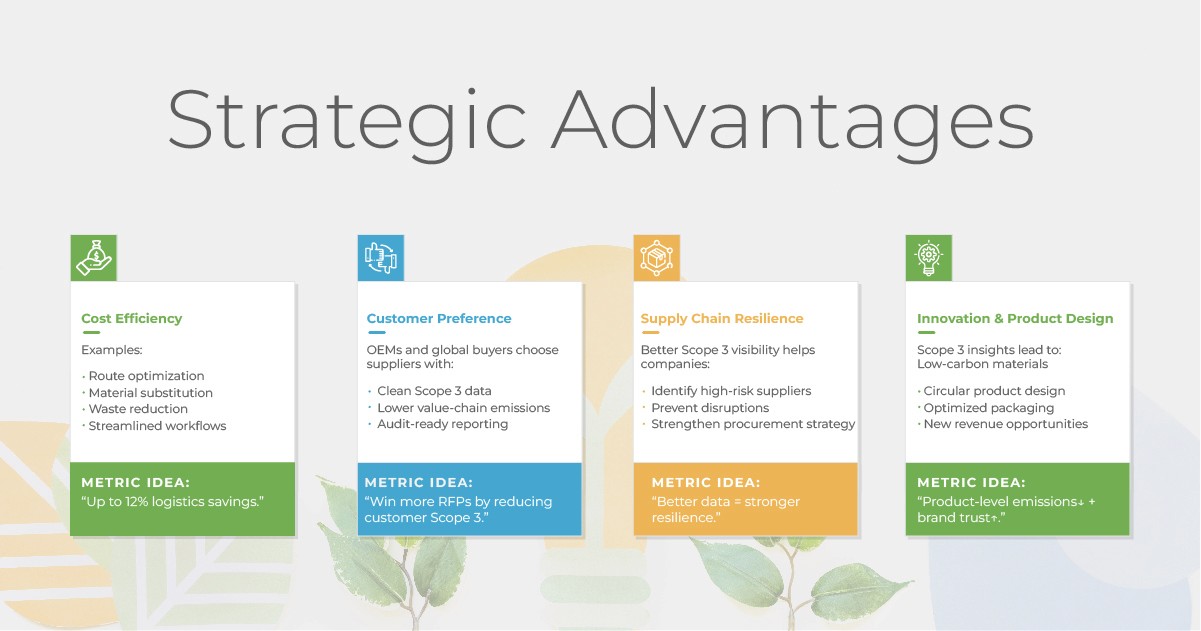
Strategic Advantages of Addressing Scope 3
Most companies first approach Scope 3 because they have to be driven by regulations, customer pressure, or investor expectations. Below are the four most significant competitive advantages companies gain when they take Scope 3 seriously.
3.1 Strengthening Reputation & Building Stakeholder Trust
In today’s markets, climate credibility is currency.
Customers, investors, and regulators increasingly expect full transparency across the value chain. Companies that proactively disclose and manage Scope 3 emissions are perceived as:
More responsible
More resilient
More future-ready
More aligned with global climate goals
The ACT Group’s analysis highlights that companies reducing supply-chain emissions earn higher trust, stronger brand loyalty, and improved investor confidence — advantages that translate directly into business performance. In an era where reputation drives customer retention and sales, Scope 3 leadership becomes a brand differentiator.
3.2 Unlocking Supply Chain Collaboration & Innovation
Scope 3 forces companies to look beyond their internal walls and work with their suppliers. This collaboration drives both innovation and resilience.
When suppliers and OEMs share data, align incentives, and co-create reduction pathways, organisations benefit from:
Better data accuracy
Shared problem-solving
Reduced risks from supply-chain disruptions
Innovation in materials, processes, and logistics
The World Economic Forum emphasises that tackling downstream and upstream emissions requires joint innovation, transport optimisation, and collaborative logistics models, all of which drive significant efficiency gains. Supply chains become smarter, more predictable, and more responsive, a huge competitive edge.
3.3 Cost Optimisation Through Operational Insights
When you measure Scope 3 emissions deeply, you uncover insights that drive cost savings.
Companies often discover:
Energy-intensive raw materials that drive both emissions and cost
Inefficient logistics routes
High-emission suppliers that are also less productive
Redundant workflows and low-value processes
Opportunities for light-weighting, redesign, or circularity
Reducing emissions often aligns perfectly with:
Lower operational costs
Improved procurement decisions
Leaner value chains
Reduced risk exposure
In other words: lower carbon = lower cost.
3.4 Driving Long-Term Innovation and Market Leadership
Businesses that tackle Scope 3 early are better positioned for long-term growth.
They adopt future-facing strategies such as:
Circular product design
Low-carbon manufacturing
Electrified or optimised logistics
New business models that reduce waste and increase reuse
Advanced AI-led forecasting and scenario modelling
Scope 3 becomes a springboard into new product categories, new revenue models, and new customer segments. In many sectors, companies that innovate here become preferred suppliers, winning contracts simply because they make their customers’ emissions lower too.
Practical Steps to Turn Scope 3 from Burden to Advantage
Most organisations struggle with Scope 3 because they approach it as a once-a-year reporting exercise. In reality, the companies winning today treat Scope 3 as a continuous, data-driven, cross-functional program.
Here’s a clear, pragmatic framework leaders can apply to start unlocking real strategic value.
4.1 Identify Your High-Impact Categories (The 80/20 Principle)
Scope 3 includes 15 categories, but not all of them matter equally for every business. High-performing companies begin by identifying:
Which categories contribute the most emissions
Which categories have the most influence (procurement, logistics, product use)
Where reliable data can be collected first
A focused approach avoids overwhelming internal teams and accelerates early wins. As PwC notes, Scope 3 becomes manageable when organisations prioritise high-impact categories, structure data inputs, and build repeatable processes — instead of trying to tackle everything at once.
4.2 Standardise and Simplify Supplier Data Collection
The biggest barrier to Scope 3 progress is supplier data chaos — spreadsheets, emails, inconsistent formats, and missing information. Leaders solve this by:
Standardising templates and data models
Providing suppliers with basic guidance
Using digital portals instead of email
Automating reminders, validations, and uploads
Incentivising timely data sharing
This transforms the process from messy and reactive to predictable and scalable. The ACT Group emphasises that supplier alignment not only improves emissions accuracy but also helps companies reduce risk, streamline operations, and build stronger supplier relationships.
4.3 Automate Data Processing, Workflows, and Reporting
Manual Scope 3 management no longer works — it’s slow, error-prone, and expensive. This is where AI-powered sustainability platforms, like OnlyGood, create step-change improvements:
Automated supplier onboarding
Digital data capture with built-in validation
AI-driven matching to GHG emission factors
Real-time dashboards across plants and suppliers
Audit trails for CBAM, GRI, CDP, BRSR, and customer portals
Instant reporting across all Scope 1, 2, and 3 categories
This automation reduces internal workload by up to 40% and accelerates data collection by up to 3×. When reporting becomes continuous and automated, Scope 3 shifts from burden to insight generator.
4.4 Engage Suppliers Through Collaboration, Not Compliance Pressure
Regulators demand supplier data, but suppliers often lack the skills, tools, or understanding to provide it accurately. The World Economic Forum highlights that tackling Scope 3 requires coordinated supplier engagement: training, shared incentives, and collaborative innovation, not one-way requests from OEMs. Leading companies build:
Supplier training programs
FAQs and guided calculators
Joint reduction plans
Workshops and capability-building
Incentives for timely and accurate data
This approach creates alignment and strengthens long-term supplier partnerships.
4.5 Integrate Scope 3 Insights into Business Decisions
Once you have reliable Scope 3 data, its value multiplies when it is used beyond reporting. Strategic companies integrate Scope 3 data into:
Procurement decisions (choosing lower-carbon suppliers)
Product design (material substitutions, light-weighting)
Logistics routing (optimising shipment emissions)
Investment choices (equipment efficiency, on-site renewables)
Pricing strategy (anticipating carbon taxes, CBAM costs)
This is where Scope 3 moves from compliance → intelligence → strategy.
4.6 Build a Long-Term Decarbonisation Roadmap
Finally, organisations that lead in Scope 3 build measurable, forward-looking plans:
Category-specific reduction targets
Supplier transition strategies
Capital planning for low-carbon technologies
Product-level carbon foot-printing
Circularity and design innovations
Quarterly progress tracking and dashboards
A roadmap signals confidence to investors, customers, and regulators and keeps teams aligned.
The Shift: From Chaos to Clarity
When organisations simplify data, digitise workflows, and collaborate with suppliers, Scope 3 stops being a burden and becomes a source of competitive advantage.
Case Studies & Evidence: How Scope 3 Drives Real Business Impact
Organisations across industries are already demonstrating that tackling Scope 3 isn’t just good for compliance, it directly improves performance, efficiency, and competitiveness. Below are three illustrative examples that show how companies are turning Scope 3 into strategic advantage.
5.1 Automotive Supplier: From Spreadsheet Chaos to Customer Preference
A Tier-2 automotive supplier struggled with fragmented, inconsistent Scope 3 data across multiple plants. Annual customer audits were painful, with teams spending weeks chasing suppliers for activity data.
Challenge:
Disconnected spreadsheets
Limited visibility into Scope 3 categories
Risk of losing preferred-supplier status with OEMs
What changed:
By digitising their ESG workflows and standardising supplier data collection, the company achieved:
100% visibility across plants and categories
3× faster supplier data collection
Audit-ready reporting for CBAM, GRI, and OEM portals
40% reduction in ESG operational workload
Strategic advantage gained: They became a “preferred low-carbon supplier”, winning additional contracts because their data made the OEM’s Scope 3 footprint lower too.
Conclusion: Scope 3 Is No Longer Optional — It’s a Strategic Advantage
For years, Scope 3 was treated as the “too hard” part of sustainability, a complex, sprawling category that sat outside the boundaries of what most organisations felt they could control. But that reality has changed. Today, stakeholders expect more. Regulations demand more. And customers reward companies that lead, not lag.
What once felt like an overwhelming reporting burden is now a powerful lever for transformation. When organizations tackle Scope 3, they unlock:
Stronger, more resilient supply chains
Lower operational costs through efficiency gains
Better product design and innovation pathways
Preferential customer selection due to reduced emissions
Reduced regulatory and carbon border risks
Enhanced brand credibility in global markets
Most importantly, they move from reactive ESG compliance to proactive value creation — turning emissions insights into strategic decisions that drive growth.
Why Now and Why It Matters
The companies who act early will be the ones shaping procurement standards, influencing industry benchmarks, and earning a competitive moat that late movers cannot easily replicate. Scope 3 is no longer a peripheral sustainability issue. It is the new frontier of business performance.
And with the rise of AI-powered platforms like OnlyGood’s end-to-end sustainability intelligence suite organisations finally have the tools to measure, manage, and reduce Scope 3 efficiently, without the chaos of spreadsheets or fragmented workflows.
The Future Belongs to Companies That Master Their Value Chain
Leaders who take control of Scope 3 today are setting themselves up for:
Better margins
Stronger customer relationships
Faster innovation cycles
And a measurable climate advantage
In a world where every supply chain decision has a carbon consequence, Scope 3 mastery is not just good ESG, it’s smart business.